Knowledge inventory
Identify valuable sources, owners, audiences and gaps.
AI knowledge assistants · Canada
Help employees find answers in your organization’s approved information. Salient AI builds AI knowledge assistants around selected documents, useful source references and access rules that are tested before the service is expanded.
Start with one useful resultDiscuss Knowledge Assistants↗
The opportunity
Policies, procedures and guidance are useful only when people can find the right version. We organize a defined body of material, identify who owns it and test whether common questions lead to supported answers. The assistant should show its sources and make uncertainty clear when the material does not answer the question. See how Salient AI consulting connects this service to leadership, adoption and a measurable business case.
What Salient AI builds
Every component makes the work, exception and accountable person easier to see.
Identify valuable sources, owners, audiences and gaps.
Define what is approved, current and appropriate for retrieval.
Organize the knowledge base around real employee questions. Check the relevance and permission of retrieved passages before evaluating generated answers.
Connect responses to the supporting documents so staff can verify the context. Define how the assistant responds to conflicting information or a question outside its sources.
Confirm what each user group may retrieve and test restricted documents explicitly. Source-platform permissions and the proposed integration must be assessed together.
Assign owners and review dates. Test revised, deleted and superseded documents so staff do not continue receiving outdated guidance after a source changes.

Connect the inputs, routine actions, exceptions and human checkpoints.
From process to practice
Knowledge management starts with clear source ownership. An AI knowledge base then needs to retrieve material that is relevant, current and permitted for the employee asking. Test both the retrieved passages and the final answer against examples your team can judge. Keep public chatbot content separate, and decide what happens when sources disagree or the answer requires information that the user may not access.
Start small
Choose one team, an approved document set and a named source owner. Prepare questions with expected sources, plus outdated, conflicting and restricted examples. Compare retrieval, answer quality and update behaviour before adding users or selecting a wider architecture.
A focused first engagementPlan the first step↗
Measure one recognizable improvement, learn from exceptions and expand responsibly.
What should improve
Frequently asked
No. A knowledge assistant can be internal, source-restricted and designed around employee tasks rather than public conversations.
That depends on the source platform and integration. Permission behaviour must be designed and tested explicitly.
We establish source ownership, review intervals and a way to retire outdated material.
No. Answers need testing against the source material, and references help users verify them. We define what should happen when information is absent, ambiguous or conflicting, including when the assistant should send the question to a person.
Scope depends on the sources, content preparation, integrations, permission requirements, number of users and expected usage. The proposal should separate setup and content work from recurring hosting, software and AI usage costs.
Retrieval-augmented generation, often called RAG, is one approach to using retrieved source material in generated answers. Start with the employee questions, source permissions and update needs. Existing search or an available assistant may be sufficient; a custom architecture is a decision to test, not a requirement.
It should answer representative questions with the right sources, decline unsupported questions, respect user access and reflect approved updates. Include questions with conflicting, outdated or restricted information and record the expected result before testing.
Related resources
Knowledge Assistants in practice
These stories show how Salient AI begins with the actual workflow, the friction and the accountable people—not a generic automation package.
Explore all client work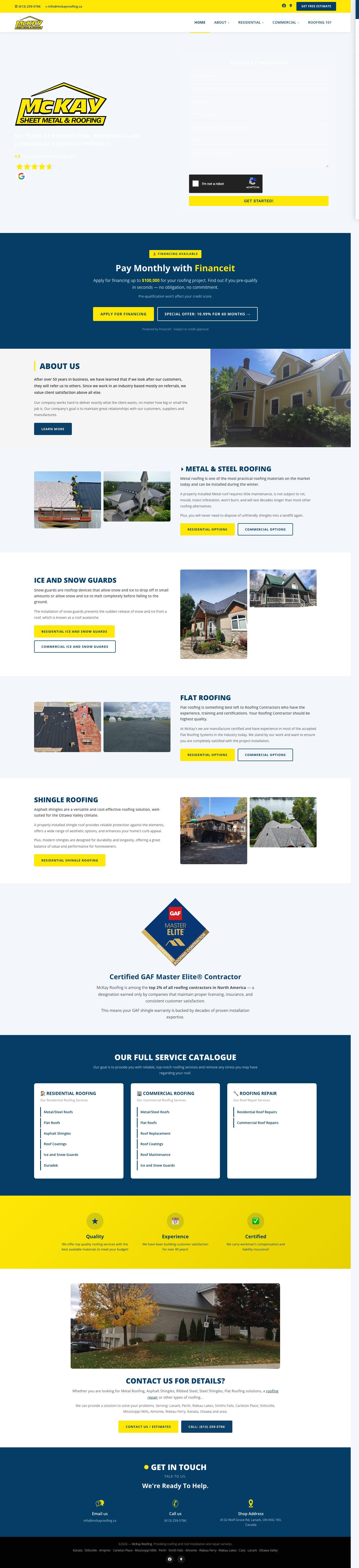
 McKay Roofing
Search visibility that earns bids, followed by a one-day prototype and an integrated operations-platform rebuild.
Read the client story ↗
 Base Bins
Marketing, ordering, payments and an AI receptionist connected around winning and closing local bin-rental leads.
Read the client story ↗
 BluSky Dental
A multilingual AI-built website, search program and AI receptionist designed around the complete lead path.
Read the client story ↗One useful beginning
Bring us one recurring administrative bottleneck. We will map a focused first result, the exceptions and the controls needed to make it useful.
A practical first stepTalk with Salient AI↗