AI concepts
What Is a Vector Database?
A vector database is a system designed to store and search numerical vectors, often embeddings of text, images or other items. It supports finding items whose vector representations are close under a chosen similarity or distance measure, usually alongside associated records and metadata.
Definition and further reading: IBM. Sources checked 8 November 2026.
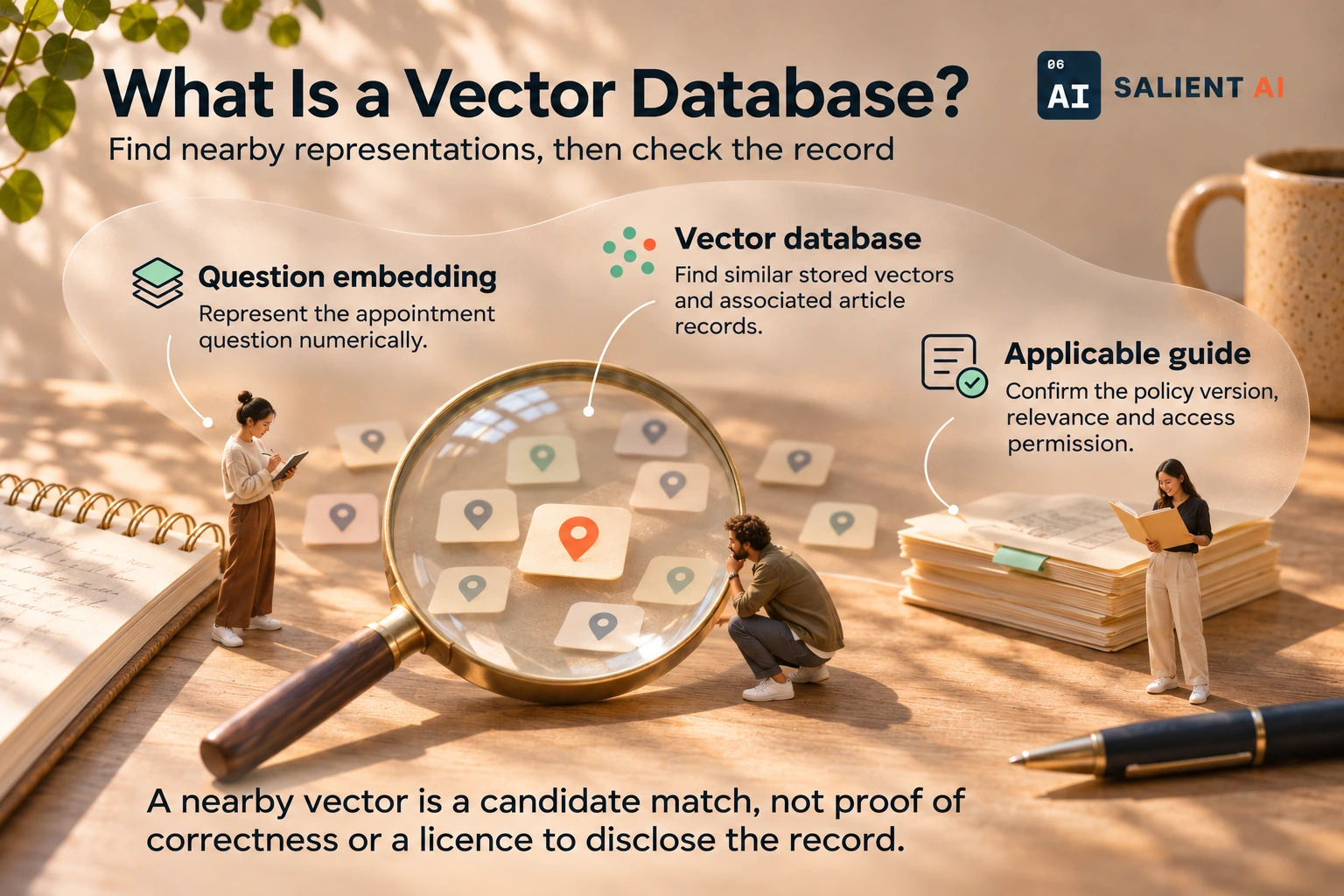
Find nearby representations, then check the record
The retrieved result still needs task-specific validation.
AI-generated illustration of a fictional business.
Read the infographic as text
The retrieved result still needs task-specific validation.
- Question embedding: Represent the appointment question numerically.
- Vector database: Find similar stored vectors and associated article records.
- Applicable guide: Confirm the policy version, relevance and access permission.
A nearby vector is a candidate match, not proof of correctness or a licence to disclose the record.
Simplified explanation based on this entry’s sources and further reading.
Why would a vector database matter to a business?
Similarity search can help find a relevant guide when the customer’s wording differs from its title. Useful results depend on the embedding model, the stored material, filtering and the search configuration. The application still needs to decide which records the requester may access.
The useful business question is whether staff can find the right information with less searching and fewer wrong turns. Test similar policies, old versions and questions using customer language. The database is part of that search arrangement; someone still needs to maintain the material and define what counts as a suitable result for the person making the request.
A practical vector database example
Illustrative example: A support system embeds an appointment question and searches stored representations of help articles. It retrieves a rescheduling guide, checks that the guide applies to the customer’s service, and supplies the approved passage to an assistant.
The team adds another guide for a different appointment type and checks that it is not used for the original customer’s question. It also tests a request for information the library does not contain. These cases help reveal whether the retrieval process supports the intended service rather than merely returning something that looks related.
A useful distinction about a vector database
Similarity is not the same as truth, relevance or permission. A vector database is not a language model and does not inherently generate an answer. Some general-purpose databases provide vector-search features, and not every retrieval task requires a separate vector database.
Storing representations and deciding what an answer should say are different jobs. The application needs a clear path from a matching record to the approved source and the final response. Ask how it handles outdated or unsuitable matches. A relevant-looking search result should remain reviewable evidence, rather than becoming an unquestioned instruction for staff or customers.
A useful first question about a vector database
Does similarity search retrieve the right permitted material for real questions, including cases where several documents look alike?
Ask staff to nominate the correct sources for a set of ordinary and confusing enquiries. Review the returned matches against those expectations and record why unsuitable results appeared. This gives the business a practical evaluation of the search experience without requiring it to inspect numerical vectors.
Sources and further reading
Want help applying this in your business?
Talk with Salient AI about your team’s needs and a practical next step.
Explore AI consulting for your business