AI concepts
What Are Embeddings?
Embeddings are numerical representations of items such as text, images or products. They encode learned features in a form software can compare, helping a system identify items that are similar according to its model.
Definition and further reading: Google Machine Learning. Sources checked 7 November 2026.
Finding similar meaning through numbers
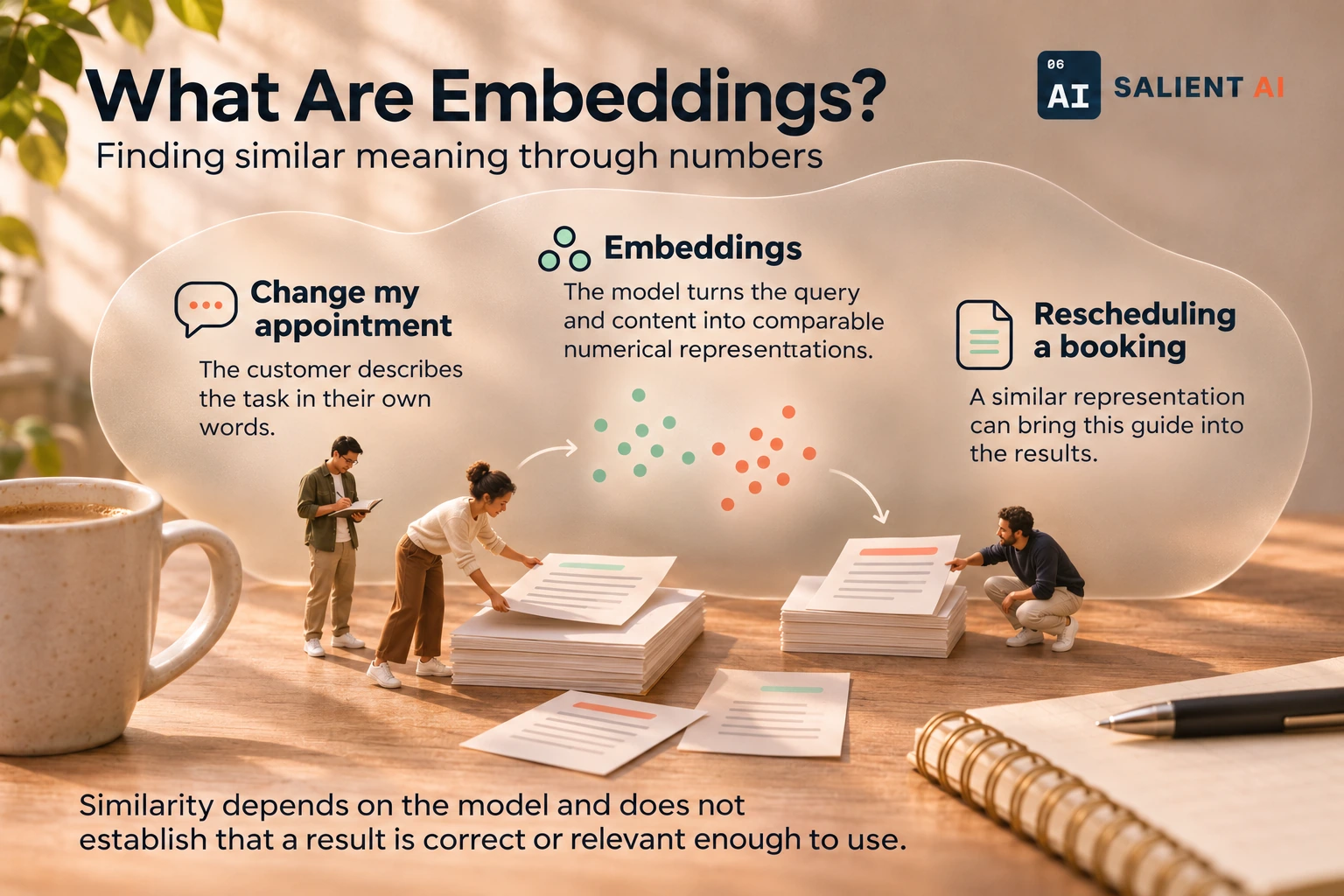
An embedding-based search compares representations of the query and candidate content.
AI-generated illustration of a fictional business.
Read the infographic as text
An embedding-based search compares representations of the query and candidate content.
- Change my appointment: The customer describes the task in their own words.
- Embeddings: The model turns the query and content into comparable numerical representations.
- Rescheduling a booking: A similar representation can bring this guide into the results.
Similarity depends on the model and does not establish that a result is correct or relevant enough to use.
Simplified explanation based on this entry’s sources and further reading.
Why would embeddings matter to a business?
They can support finding related material even when a customer's wording differs from the wording in your documents. That can be useful in document search and information retrieval for an AI assistant.
The business value is easier access to information people describe in their own words. Before adopting this approach, collect examples of questions staff or customers actually ask. Include different expressions for the same need and similar wording for different needs. Those cases help assess whether the search makes the right material easier to find in practice.
A practical embeddings example
Illustrative example: someone searches a support library for “change my appointment.” An embedding-based search may retrieve a guide called “Rescheduling a booking,” which the person can then check.
The team also searches for cancelling an appointment and changing contact details. It checks whether the results distinguish those tasks from rescheduling. A staff member reviews the retrieved guide before using its instructions, so finding a related title remains the beginning of the information check rather than the end.
A useful distinction about embeddings
Similarity is not proof of accuracy or permission to disclose a document. The application still needs suitable source material, access controls and checks on retrieved results.
A related result can still be the wrong version or apply to a different service. Keep relevance, currency and access as separate review questions. The useful result is an approved document that answers the actual request, not simply a document whose wording or subject resembles it.
A useful first question about embeddings
Can the search retrieve the right approved document for real customer questions, including cases where several documents look similar?
Build a small set of common and confusing questions and have staff identify the preferred source for each. Compare the search results with those expectations. This creates a practical way to discuss retrieval quality without requiring the owner to interpret the underlying numerical representations.
Sources and further reading
Want help applying this in your business?
Talk with Salient AI about your team’s needs and a practical next step.
Explore AI consulting for your business