Platforms and tools
What Is Meta Muse?
Meta Muse is Meta’s personal AI agent, designed to work on tasks and longer-term goals through connected services. Meta describes it as running on its own computer in the cloud, with a browser, and accessible through the Muse app or WhatsApp. The agent can continue working between messages.
Definition and further reading: Meta. Sources checked 21 November 2026.
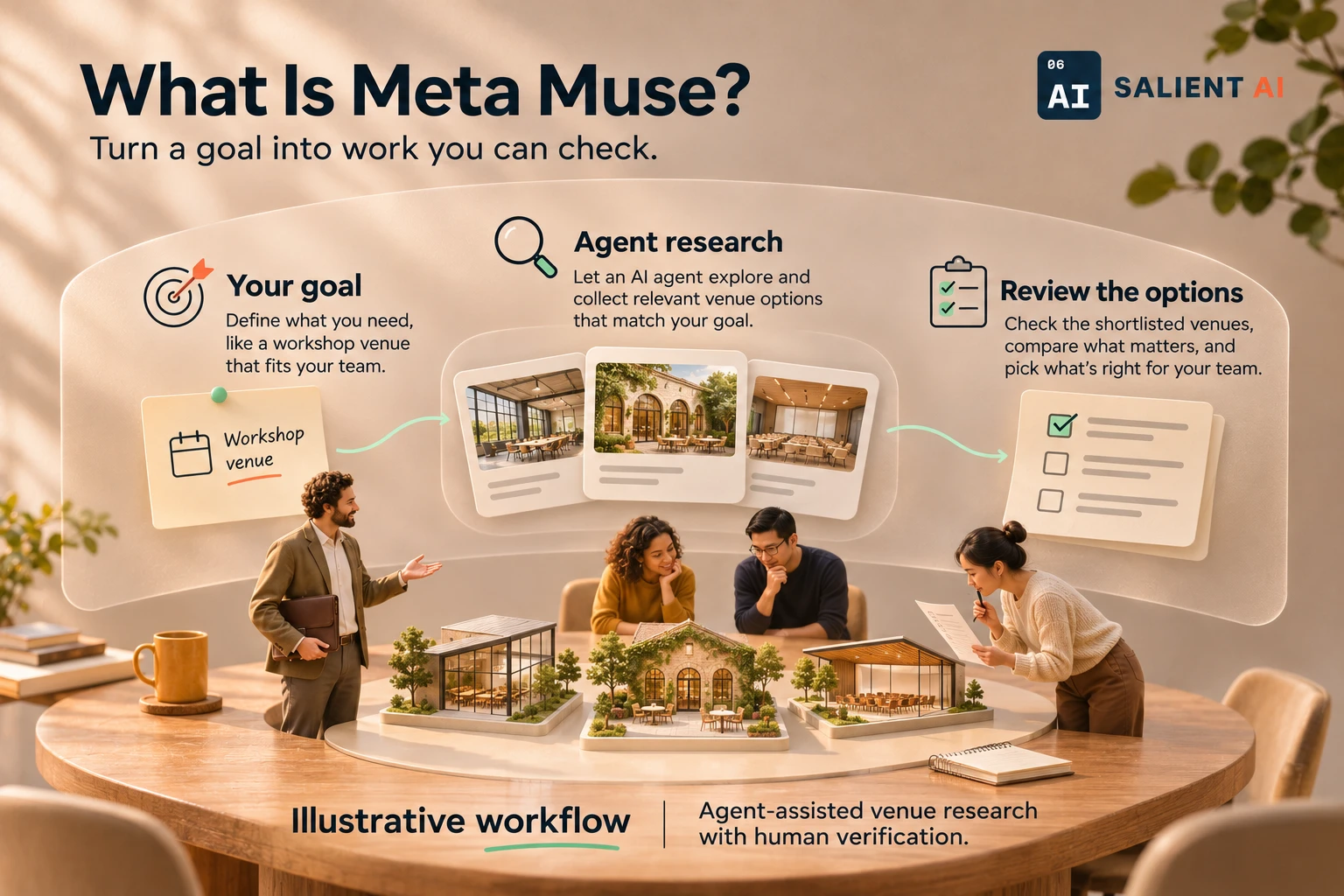
Turn a goal into work you can check.
Illustrative workflow with agent-assisted venue research and human verification.
AI-generated illustration of a fictional business.
Read the infographic as text
Illustrative workflow with agent-assisted venue research and human verification.
- Your goal: Define what you need, like a workshop venue that fits your team.
- Agent research: Let an AI agent explore and collect relevant venue options that match your goal.
- Review the options: Check the shortlisted venues, compare what matters, and pick what’s right for your team.
Check the sources and review proposed actions before making a commitment.
Simplified explanation based on this entry’s sources and further reading.
Why might a business owner be interested in Meta Muse?
For an owner who handles administration alongside customer work, even a small research task can create several interruptions. Finding possible venues for a workshop means gathering options, comparing practical details and remembering what still needs a decision. A personal agent offers a way to explore delegating some of that coordination.
Begin with an outcome that can be checked without making a commitment. A shortlist is useful when it includes the constraints you supplied and links you can inspect. Treat the time needed to verify it as part of the work. A tidy presentation alone does not tell you whether the options are suitable.
A practical Meta Muse example
Illustrative example: a small business owner asks Muse to research possible venues for a staff workshop. They supply the intended date, approximate group size and accessibility requirements, and ask for a comparison of publicly available information. The instruction says to leave enquiries and reservations for the owner.
The owner opens the source pages, removes an unsuitable option and contacts the remaining venues to confirm availability. Any missing accessibility detail becomes a question for the venue. This example illustrates a bounded research task; it is not a Salient client story or a claim that an agent’s shortlist guarantees a suitable booking.
How does the Muse agent differ from an AI model?
The personal agent is the product that coordinates tasks and uses tools. Meta names Muse Spark as a model powering it. A model name and an agent product name therefore describe different parts of the system. This entry concerns the personal agent, rather than every Meta product carrying the Muse name.
Meta says users choose connected services and that Muse seeks approval for sensitive actions such as emails and purchases. Those are vendor descriptions, not an independent guarantee. Check current availability and account controls before using it with business material; the launch announcement’s US rollout does not establish Canadian availability.
What should you check before delegating work to Muse?
Start by deciding what a successful result would contain. For a venue search, list the requirements that would rule an option out, then specify the evidence you expect for each remaining choice. Give the person reviewing the result enough time to contact venues and resolve gaps before a booking deadline.
Keep the first trial small enough to compare with your usual process. Record wrong details, missing sources and the effort needed to make the answer usable. If the result is helpful, repeat the same type of task before expanding its responsibilities. The useful question is whether the reviewed work makes the owner’s day easier.
Sources and further reading
Choose a useful first task
Discuss where a personal AI agent might help and how your team will check its work.
Explore AI consulting