AI concepts
What Is a Token?
A token is a unit that an AI model uses to represent and process information. For a language model, text is divided into tokens that may correspond to words, parts of words, punctuation or other character sequences, then represented internally by identifiers.
Definition and further reading: Hugging Face, Anthropic. Sources checked 8 November 2026.
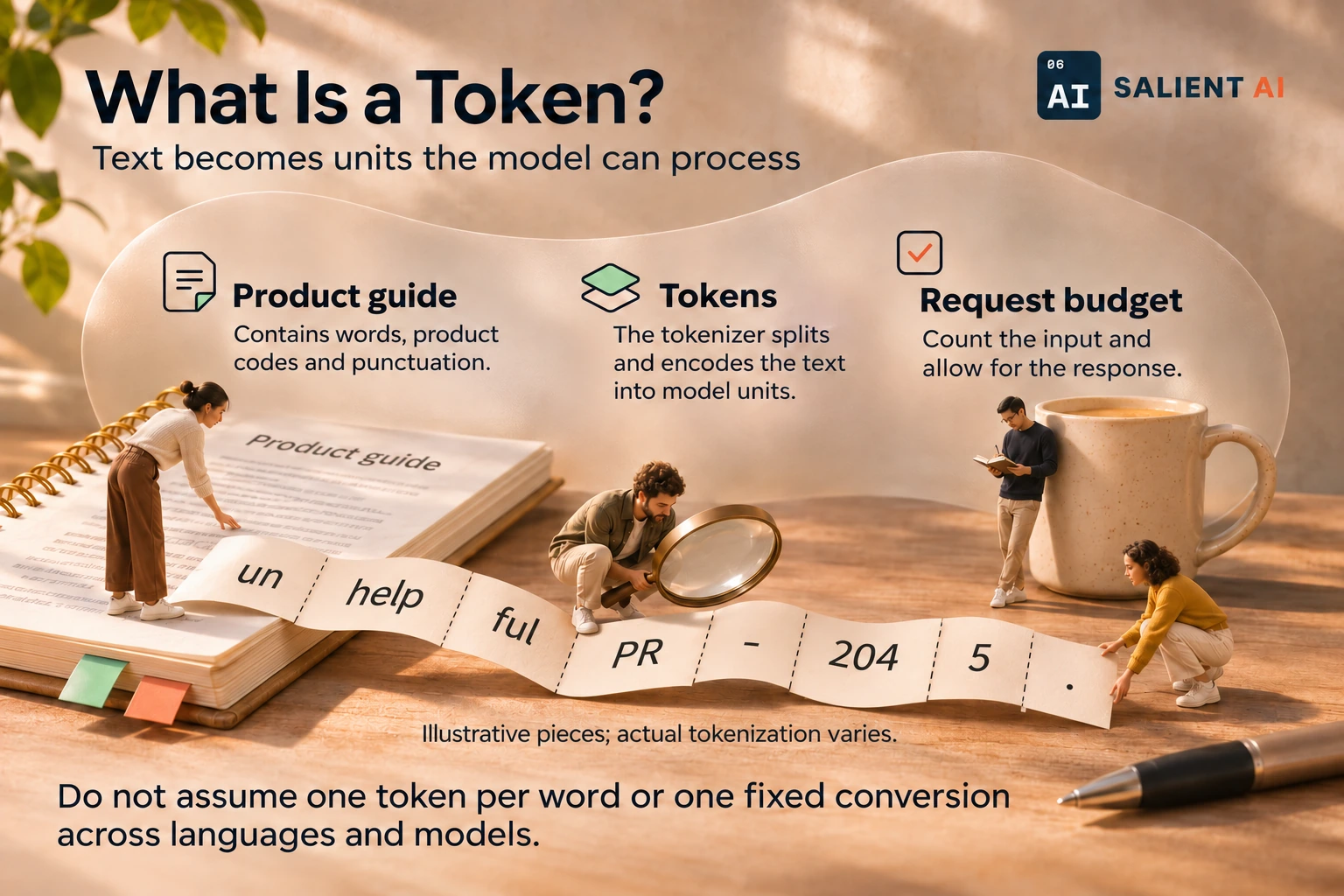
Text becomes units the model can process
The tokenizer determines where the boundaries fall.
AI-generated illustration of a fictional business.
Read the infographic as text
The tokenizer determines where the boundaries fall.
- Product guide: Contains words, product codes and punctuation.
- Tokens: The tokenizer splits and encodes the text into model units.
- Request budget: Count the input and allow for the response.
- Illustrative pieces: un | help | ful | PR | - | 204 | 5 | . Actual tokenization varies.
Do not assume one token per word or one fixed conversion across languages and models.
Simplified explanation based on this entry’s sources and further reading.
Why would a token matter to a business?
Token counts affect how much material can fit in a request and are often used in usage limits or pricing. A long document, repeated conversation history and the generated response can all contribute. Exact accounting depends on the model and service.
For an owner, the practical questions are how much material the task needs and what the complete request costs to run under the selected service. Keep those questions tied to a real example. Repeatedly including irrelevant documents may add work without improving the answer, while removing necessary evidence can undermine a result that initially appears cheaper or faster.
A practical token example
Illustrative example: A team estimates the size of a request containing a long product guide before asking for a summary. It uses the selected model’s tokenizer or counting tool, rather than assuming that every word occupies exactly one token.
The team identifies the parts of the guide relevant to the requested summary and preserves the qualifications needed to interpret them. It leaves room for the answer and checks the returned summary against those sections. The exercise connects capacity planning to the actual information task, rather than treating the document’s page count as a sufficient estimate.
A useful distinction about a token
A token is not necessarily a word, and the same text can produce different counts with different tokenizers. Token counts alone do not measure answer quality. In other computing contexts, “token” can also mean an authentication credential; that is a different use of the word.
Counting input is an operating measure, not a verdict on the usefulness of a task. A short answer can be wrong, and a longer response can still omit the point the business needs. Assess the result separately for accuracy and relevance. Use the selected service’s actual accounting information when estimating usage instead of relying on a universal words-to-tokens rule.
A useful first question about a token
How does this model count the actual material being sent, and is there sufficient capacity for the required response?
Use a representative request with its instructions, source material and expected answer length. Ask how the application handles material that does not fit. This makes the limit a concrete design consideration rather than an unfamiliar number on a product comparison sheet.
Sources and further reading
Want help applying this in your business?
Talk with Salient AI about your team’s needs and a practical next step.
Explore AI consulting for your business