Search and discovery
What Is GEO?
GEO, or generative engine optimisation, is work intended to improve how content is represented or referenced in answers produced by generative search systems. It involves making useful information understandable and supportable, then assessing whether and how those systems use it.
Definition and further reading: Aggarwal and colleagues, Google Search Central. Sources checked 8 November 2026.
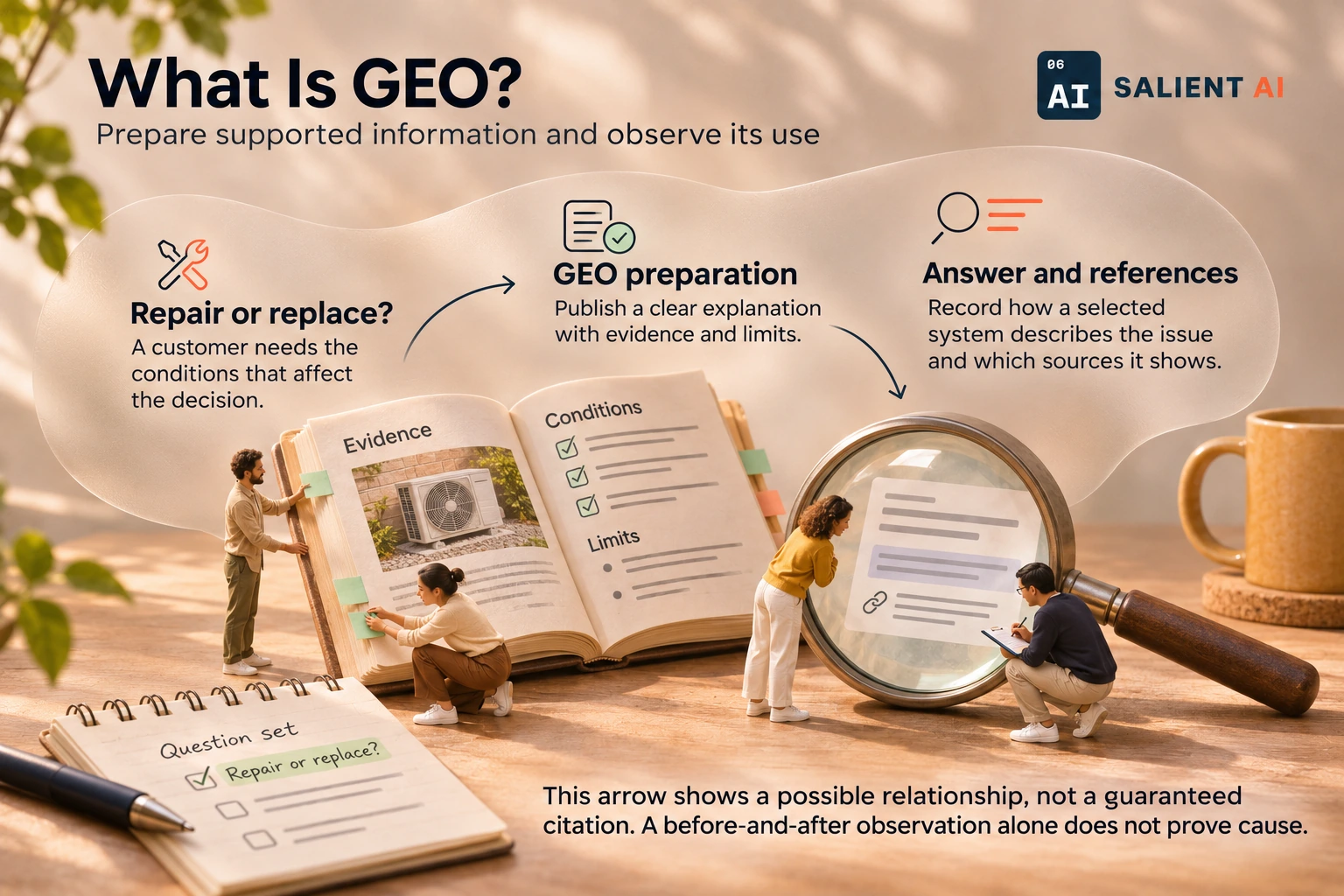
Prepare supported information and observe its use
GEO concerns representation in generative answers; the result remains outside the publisher’s control.
AI-generated illustration of a fictional business.
Read the infographic as text
GEO concerns representation in generative answers; the result remains outside the publisher’s control.
- Repair or replace?: A customer needs the conditions that affect the decision.
- GEO preparation: Publish a clear explanation with evidence and limits.
- Answer and references: Record how a selected system describes the issue and which sources it shows.
This arrow shows a possible relationship, not a guaranteed citation. A before-and-after observation alone does not prove cause.
Simplified explanation based on this entry’s sources and further reading.
Why would GEO matter to a business?
An AI-generated answer may influence a customer's understanding before they visit a website. A business needs accurate, accessible information about its services and evidence for its claims. Record observations against specific questions and systems; one favourable answer does not establish dependable visibility or commercial results.
For a founder, a useful starting point is the explanation a prospective customer needs, not a technique promised to influence every system. Identify the claims the business wants represented accurately and provide the context that qualifies them. Then treat observed answers as evidence to inspect, with a record of where and when they appeared and whether they reflected the source faithfully.
A practical GEO example
Illustrative example: a repair business publishes a clear explanation of repair versus replacement, including the conditions that require an inspection. The team samples relevant questions in selected generative search tools and records the date, answer and sources shown. Changes in those observations guide further investigation, not a claim of proven causation.
The business compares each observed answer with its approved explanation and notes whether inspection requirements were preserved. If a system omits an important limitation, the team records the mismatch rather than claiming the answer is a successful mention. It also reviews whether the underlying page explains the issue clearly for a person arriving directly, independent of any generated summary or citation.
A useful distinction about GEO
GEO overlaps with SEO and AEO; it is not a universal technical standard or guaranteed inclusion method. Google says its AI search features use the existing SEO foundations and require no special AI markup. The original GEO research examines visibility in an experimental setting; its results should not be presented as a promised improvement for a particular business or platform.
Keep the terms, the work and the evidence separate. A supplier may use GEO to describe content changes, source work or monitoring, but the label does not establish which activity caused a result. Ask for a clear account of what changed, what was observed and what uncertainty remains. This allows the business to assess useful work without accepting experimental findings or isolated examples as a general performance guarantee.
A useful first question about GEO
Which customer question should the content answer, what evidence supports the explanation, and what observations would show that a system represented it accurately?
Select a specific question and write down the facts and limitations a satisfactory answer should contain. Use that as a review standard for both the website and observed generated responses. Record differences and gaps before deciding what action the evidence justifies.
Sources and further reading
Want help applying this in your business?
Talk with Salient AI about your team’s needs and a practical next step.
Explore AI consulting for your business