Search and discovery
What Is AEO?
AEO usually means answer engine optimisation. It is an industry term for improving information so answer-based systems can find, understand and potentially use it when responding to a question. The label is used inconsistently and can overlap with SEO and generative engine optimisation.
Definition and further reading: Google Search Central. Sources checked 7 November 2026.
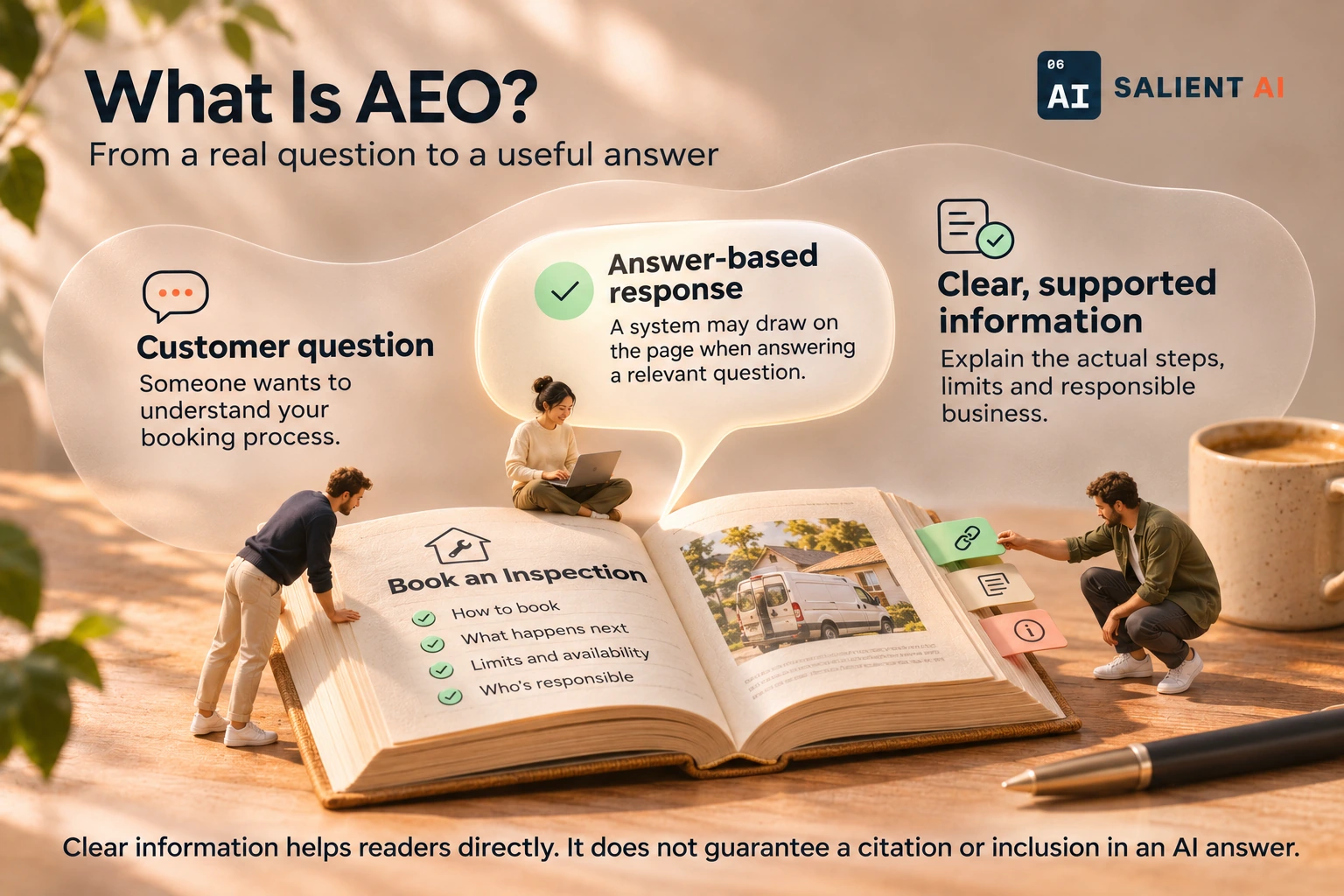
From a real question to a useful answer
AEO concerns the information an answer-based system may find and use.
AI-generated illustration of a fictional business.
Read the infographic as text
AEO concerns the information an answer-based system may find and use.
- Customer question: Someone wants to understand your booking process.
- Clear, supported information: Explain the actual steps, limits and responsible business.
- Answer-based response: A system may draw on the page when answering a relevant question.
Clear information helps readers directly. It does not guarantee a citation or inclusion in an AI answer.
Simplified explanation based on this entry’s sources and further reading.
Why would AEO matter to a business?
People increasingly encounter explanations and recommendations within generated answers. Clear service information, identifiable sources and evidence can help someone assess your business wherever they discover it. No formatting technique guarantees that an answer system will select or cite a page.
For an owner, the practical work starts with information the business can stand behind. Explain the service, its limitations and the next step clearly enough for a customer to assess directly. That creates a useful foundation for discovery across different interfaces. Any observation about an answer system should be recorded with its context rather than treated as a permanent endorsement of the company.
A practical AEO example
Illustrative example: a service provider answers a recurring question about its booking process. The page states the actual steps and limitations, identifies who provides the service and links to fuller information. It gives a prospective customer something useful even if no AI system cites it.
The provider asks staff whether the explanation matches the questions they receive and whether it leaves any important condition unstated. If an answer system later references it, the team checks what was actually said and which passage was used. The page remains maintained for customers, even when the system’s wording or choice of sources changes.
A useful distinction about AEO
Google says established SEO practices remain relevant to its AI search features and that there are no additional technical requirements for eligibility as a supporting link. That guidance concerns Google’s features; other providers have their own systems and controls. AEO is not a universal certification or special markup requirement.
Separate an editorial improvement from a claim about distribution. Clearer wording and evidence can make a page more useful to its readers, but that does not establish that a particular system will include it. Ask a supplier to distinguish the work being done from the outcomes being observed, and to explain what remains outside the business’s control.
A useful first question about AEO
Does the page answer a real customer question accurately and with evidence? Establish that before trying to optimise for a particular answer format.
Choose a recurring question and review the answer with the staff who handle it. Confirm the facts and limitations, then inspect any observed AI representation against that source. This keeps the work centred on accurate customer information rather than an unsupported promise of inclusion.
Sources and further reading
Want help applying this in your business?
Talk with Salient AI about your team’s needs and a practical next step.
Explore AI consulting for your business