AI concepts
What Is a Chatbot?
A chatbot is software that interacts with people through a conversational interface, using text or voice. It may follow predefined questions and responses, generate replies with an AI model, or combine both approaches to provide information and help complete a task.
Definition and further reading: IBM. Sources checked 8 November 2026.
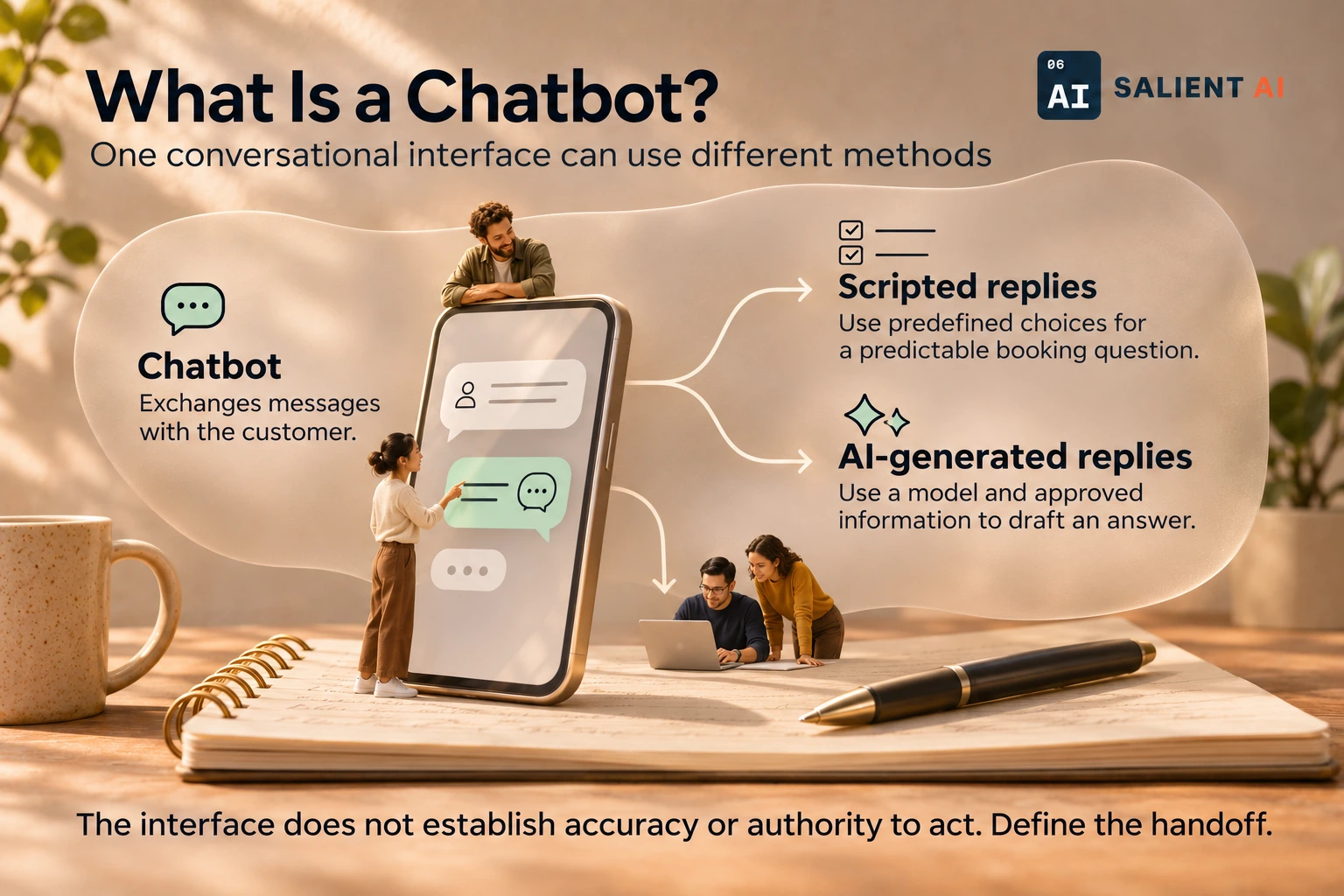
One conversational interface can use different methods
Choose the response method around the customer’s task.
AI-generated illustration of a fictional business.
Read the infographic as text
Choose the response method around the customer’s task.
- Scripted replies: Use predefined choices for a predictable booking question.
- Chatbot: Exchanges messages with the customer.
- AI-generated replies: Use a model and approved information to draft an answer.
The interface does not establish accuracy or authority to act. Define the handoff.
Simplified explanation based on this entry’s sources and further reading.
Why would a chatbot matter to a business?
A conversation is useful when it leads somewhere dependable. Customers need accurate answers, a clear explanation of what the bot can do and a practical route to a person when the request falls outside its scope.
For the business, the conversation is part of the service experience. Decide what the visitor should achieve and how the team will receive unresolved requests. A chatbot that provides a clear next step can be useful; one that repeatedly asks questions without advancing the task can create extra work for both the customer and the staff member who eventually responds.
A practical chatbot example
Illustrative example: A repair website asks whether the visitor needs glass replacement or a hardware adjustment. The chatbot supplies relevant booking information and passes an unusual repair question, with the conversation details, to staff.
A staff member reviews the handoff and checks that the customer does not need to repeat information already supplied. The team also tries an unclear description and a question outside its services. These cases reveal whether the conversation explains its limits and gives the visitor a workable way to continue, instead of producing an irrelevant answer.
A useful distinction about a chatbot
Not every chatbot uses generative AI. A scripted flow can work for predictable requests, while a generative system can handle varied language but may produce unsupported answers. A chat interface also does not prove that booking, payment or customer-record integrations exist.
Separate the conversation from the actions behind it. A bot may describe available appointments without actually reserving one, or collect details without creating a staff task. Ask the provider to demonstrate the end result in the destination system. That helps establish what the customer can rely on when the chat says a request is complete.
A useful first question about a chatbot
Which customer requests can this conversation resolve, and what happens when the bot cannot answer or the connected service fails?
Write down the requests the bot should resolve and those it should hand over. For each handoff, identify the receiving person, the information they need and the message the customer sees. Test that arrangement with an awkward request before expanding the bot’s scope.
Sources and further reading
Want help applying this in your business?
Talk with Salient AI about your team’s needs and a practical next step.
Explore AI consulting for your business