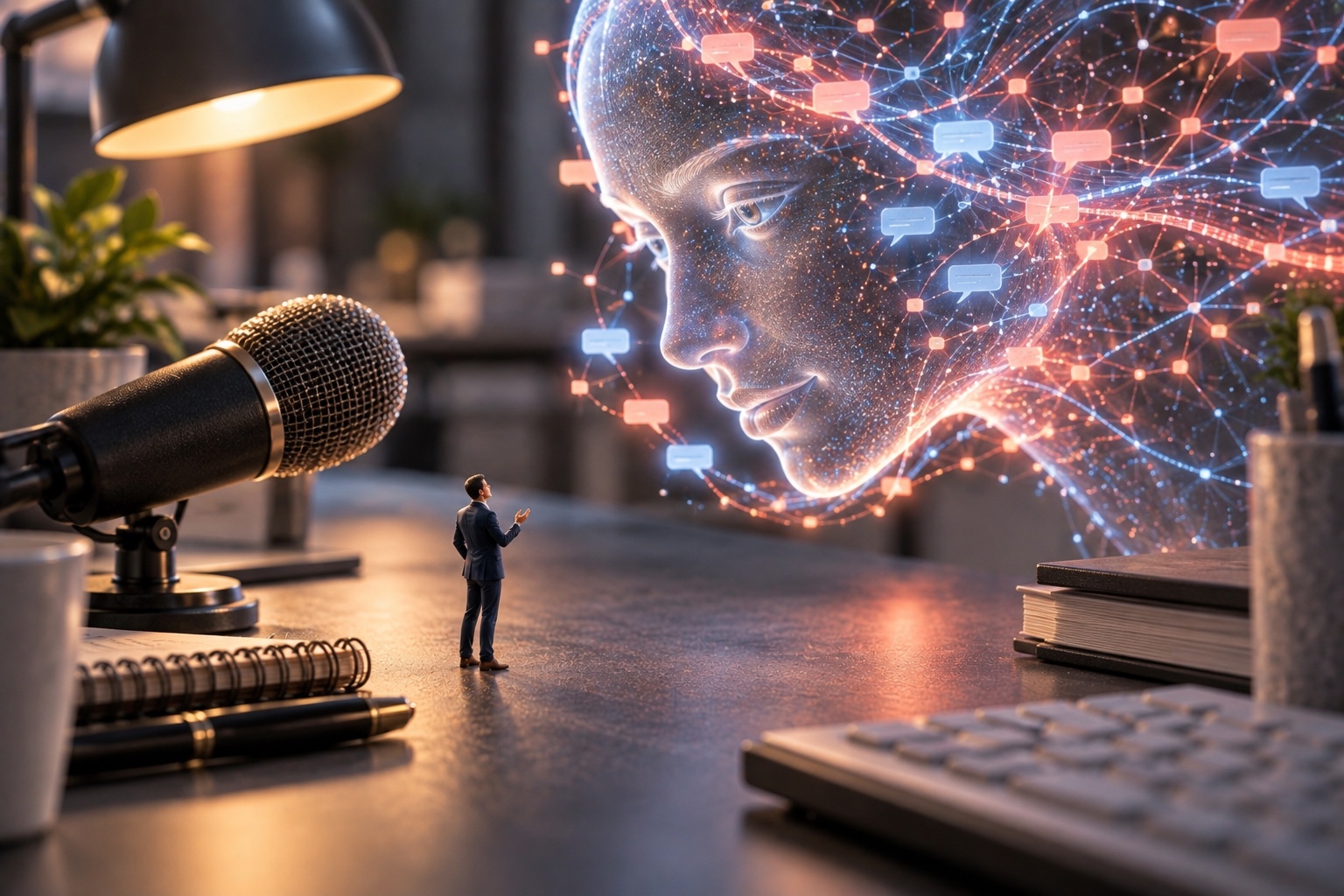
Sometimes AI gives you an answer that makes you stop.
It may understand the point behind your question. It may notice that you are uncertain, change its tone and explain the answer in a way that feels personal. If you speak to it instead of typing, the conversation can feel even more natural.
I talk to AI this way all the time. The better the systems become, the easier it is to feel that someone—or something—is on the other side of the conversation.
So, is AI alive? Is it conscious? Is it becoming human?
Human-like behaviour is not evidence of conscious experience. Whether an artificial system could be conscious remains an open research question; the fluent conversation alone cannot settle it.
It can sound as though it understands your feelings, but that performance does not demonstrate an inner experience.
That does not make it useless or unintelligent. It means we need to separate what AI can do from what AI is.
Think of AI as a GPS for language
A GPS has a huge map showing how roads connect. You give it a destination. It studies the possible routes and tells you the next turn. Once you make that turn, it calculates again.
AI does something similar with language.
First, it breaks your question into small pieces called tokens. A token may be a whole word, part of a word or even punctuation. The system then uses a neural network—a very large mathematical map of relationships learned during training—to calculate which token should come next.
It adds that token to the answer, looks at the growing conversation and calculates again. It repeats this process, one small step at a time, until the answer is complete.
Google's explanation of large language models describes the same process. The model predicts tokens from the text before them and uses attention to weigh which parts of the context matter most.
The model does not pull a finished paragraph from a filing cabinet. It builds the response as it goes.
Like a GPS, it can produce an excellent route without knowing what it feels like to take the trip. It does not feel the rain, become impatient in traffic or enjoy arriving. It calculates relationships and produces the next useful step.
The comparison also explains why AI can go wrong. If the destination is unclear, the map is incomplete or an early turn is mistaken, it may continue confidently down the wrong road.

Why AI can feel so human
Human beings naturally look for a mind behind language.
If something remembers the conversation, responds to our mood, uses humour and speaks in the first person, we begin to treat it socially. We say the AI “thinks,” “knows,” “wants” or “understands.” Those words make the interaction easier, but they can also fool us.
The system has learned from an enormous amount of human language. It has learned the patterns of sympathy, disagreement, encouragement, expertise and humour. When you provide more context—and especially when you speak to AI as part of a real conversation—it can choose language that fits you surprisingly well.
The result can be convincing. In a 2025 preregistered Turing-test study, participants spoke with a human and an AI for five minutes. When GPT-4.5 used a human-like persona, participants chose it as the human 73% of the time.
That shows how well AI can imitate human conversation. It does not prove that the AI was conscious. Passing for human and being human are different things.

Intelligence, consciousness and life are not the same
People often combine three separate questions:
- Is it intelligent? Can it solve problems, use information and complete difficult work?
- Is it conscious? Is there an inner experience—something that it feels like to be that system?
- Is it alive? Is it a living organism with biological processes?
Current AI can show impressive forms of intelligence. It can write, code, analyze documents, use software and help solve business problems. As I discussed in the honest truth about AI and our jobs, those abilities are already changing how quickly some work can be completed. But strong performance is not proof of an inner life.
Commander Data from Star Trek: The Next Generation helps illustrate the distinction. He can process enormous amounts of information and solve difficult problems, yet struggles to understand humour, grief and love. Star Trek treats Data as self-aware, so he is not a perfect comparison with today's AI. He does show that intelligence, emotion and consciousness are different questions.
A calculator can outperform a person at arithmetic without understanding money. A GPS can find a route without wanting to go anywhere. In the same way, an AI may create a thoughtful answer without privately thinking or feeling behind the words.
Scientists do not yet have a universally accepted test for consciousness—even in every biological case—so we should avoid pretending the question is completely settled forever. An interdisciplinary review of AI consciousness concluded that the systems it assessed were not conscious. It also said there were no obvious technical barriers to building future systems that meet some proposed indicators of consciousness.
The honest position is straightforward: we have no good reason to treat today's AI as conscious, and we do not know what may become possible in the future.

AGI is about broad ability—not automatically consciousness
This is where artificial general intelligence, or AGI, enters the conversation.
There is no single definition of AGI. OpenAI's charter describes it as highly autonomous systems that outperform humans at most economically valuable work. Google DeepMind's Levels of AGI framework looks at performance, how broadly a system can work and how much autonomy it has.
But what would AGI mean in practice?
Imagine one worker trained for a single task. Then imagine another who can enter an unfamiliar department, read the instructions, understand the goal and work out what to do next.
AGI is closer to the second example. It would be able to handle a much wider range of work, learn unfamiliar tasks, connect knowledge across fields and operate with less direction. It might be more capable than a person in many areas.
Notice what the definitions measure: capability. They do not measure feelings or an inner experience. In the same way, a company's access to more capable AI does not mean the organization is ready to use it. That gap between technical possibility and practical readiness is a form of AI institutional lag.
None of that automatically means AGI would feel fear, hope, pain, ambition or curiosity.
A system could become extremely capable without anyone being “home” inside it. It could solve a difficult scientific problem or speak about its supposed feelings in great detail because it has learned how people communicate.
AGI and consciousness may eventually become connected questions, but they are not the same question.

Human-like language can create a business risk
For a business, this is not only a philosophical discussion.
The more human AI sounds, the easier it is to give it human authority. An employee may trust a confident answer because the system seems thoughtful. A customer may believe a warm chatbot genuinely cares. A manager may treat an AI recommendation like the judgement of an experienced adviser. Giving everyone an account does not solve this problem; AI access is not the same as responsible integration.
But AI does not accept responsibility for the outcome.
It does not lose sleep when a customer is harmed. It does not understand a company's values through years of lived experience. It cannot be held accountable when a private document is mishandled or an important exception is missed.
This is why responsible AI requires visible human ownership. AI may prepare the answer, summarize the case or recommend the next step. A person still needs to own decisions involving safety, privacy, empathy, money or serious consequences.
The goal is not to make AI less useful. It is to use its ability without confusing a human-like performance with a human being.
The better question is what responsibility we give it
AI is going to feel more alive as conversations become smoother, voices become more expressive and systems remember more context. Future agents may complete longer assignments while interacting with us in increasingly personal ways.
We should not judge them by how alive they appear.
We should judge whether their work is accurate, whether their boundaries are clear and whether a real person remains responsible for the result. That is also why organizations should start with a small, complete AI implementation instead of handing broad authority to a system simply because it sounds capable.
AI does not have to be alive to change your business. It does not have to be conscious to produce valuable work. And it does not have to be human for people to start treating it as though it is.
That final point may be the one we need to watch most carefully.
Put the idea to work
Keep AI consciousness separate from evidence of useful capability.
Fluent conversation is not enough to establish conscious experience. Butlin and colleagues’ 2023 research proposes indicators drawn from theories of consciousness; it is a framework for investigation, not a definitive test that settles every present or future system.
For an organization, evaluate the behaviour you can inspect: factual accuracy, handling of uncertainty, information access and the route to a human. Assign responsibility to people rather than inferring an inner experience from the tone of an answer.
Further reading: Butlin et al., Consciousness in Artificial Intelligence (2023)
Written from Stephen Lau's experience and point of view, with AI-assisted research and editorial production. Reviewed by Salient AI before publication.