If you run a business in Canada, you may be wondering whether you can get in yet. The answer is a little more complicated than “yes” or “join the queue.”
OpenAI has launched Businesses in ChatGPT in beta, with a Business Hub where eligible businesses can claim their organization, provide information and see how people engage with them. Business Agents—the customer-facing assistants that answer questions on a business’s behalf—are starting with eligible U.S. ecommerce and online service businesses. OpenAI’s announcement
So the velvet rope is still there, but it isn’t wrapped around every Canadian business. Eligibility depends on your business type and the verification available. OpenAI currently limits local stores and restaurants to claiming an existing U.S. listing. Canadian online businesses should check their eligibility rather than assume they have to wait. Current setup and eligibility
Before you treat this like another tech headline to ignore until next quarter, take a lesson from Game of Thrones: winter is coming. I wouldn’t write traditional search’s obituary, but I would get my business information ready for another way customers can find me.
From map pins to Jarvis
For years, local visibility has meant maintaining your listings on Google Business Profile, Apple Business Connect and Bing Places. Those platforms still matter. Someone searches “coffee shop near me,” checks your hours and decides whether to visit.
Now consider a different question:
“Where can I buy a locally roasted espresso blend with same-day pickup and a generous return policy?”
That is a lot to squeeze into a map pin.
ChatGPT can help people compare products using their needs, preferences and budget. OpenAI says its shopping results draw on product information from merchants and other providers, and can include summaries of reviews from public websites. How ChatGPT shopping works
It starts to feel a little more like Tony Stark’s Jarvis: a conversation that helps you work through the decision.
For the business owner, the practical question is simple. Have you actually made the information available? Does your website explain pickup, delivery, returns and what makes the product suitable?
Those are the same customer questions that give you useful SEO topics. Your staff may answer them every day. Your website should help answer them too.

How the big four fit together
I wouldn’t treat Business Hub as a reason to abandon the listings you already have.
- Google Business Profile: Keep the essentials accurate for people finding you through Google Search and Maps.
- Apple Business Connect: Another place to manage how your business appears across Apple’s services, including Maps and Siri. Apple’s overview
- Bing Places: Often overlooked—like the quiet kid in a John Hughes movie who turns out to matter more than anyone expected. Keep it accurate, but don’t confuse a tidy Bing listing with a guaranteed ChatGPT recommendation.
- ChatGPT Business Hub: A place for eligible, verified businesses to supply details and product feeds, and review insights such as mentions and website clicks. Claiming a business does not buy control over ChatGPT’s independent answers. Business Hub guidance
OpenAI documents using Bing for some ChatGPT search experiences. That gives us a reason to pay attention to the wider search ecosystem. It does not establish that Bing Places is a secret shortcut into ChatGPT’s recommendations. OpenAI’s search documentation
The wider principle is familiar: being the best-kept secret in your market isn’t much of a marketing strategy. Make it easier for customers to discover what you actually offer.
Your Canadian “don’t wait around” action plan
Whether you can claim your business today or still face restrictions, there is useful work you can do this week.
1. Run the “Mirror, Mirror” test
Open ChatGPT, ask it to search the web, and try:
“What does [business name] in [city] sell? What are its opening hours, delivery or pickup options, and return policy? Show your sources and tell me what you couldn’t verify.”
Then try a question a real customer would ask about choosing a business like yours.
Check the answer against the facts. Follow the source links. Is it using an old page? Confusing you with a similarly named business? Missing a service you actually provide?
One answer is a spot check, not a verdict on your visibility. Repeat useful questions over time and inspect why competitors appear in AI answers.
2. Give your listings a reality check
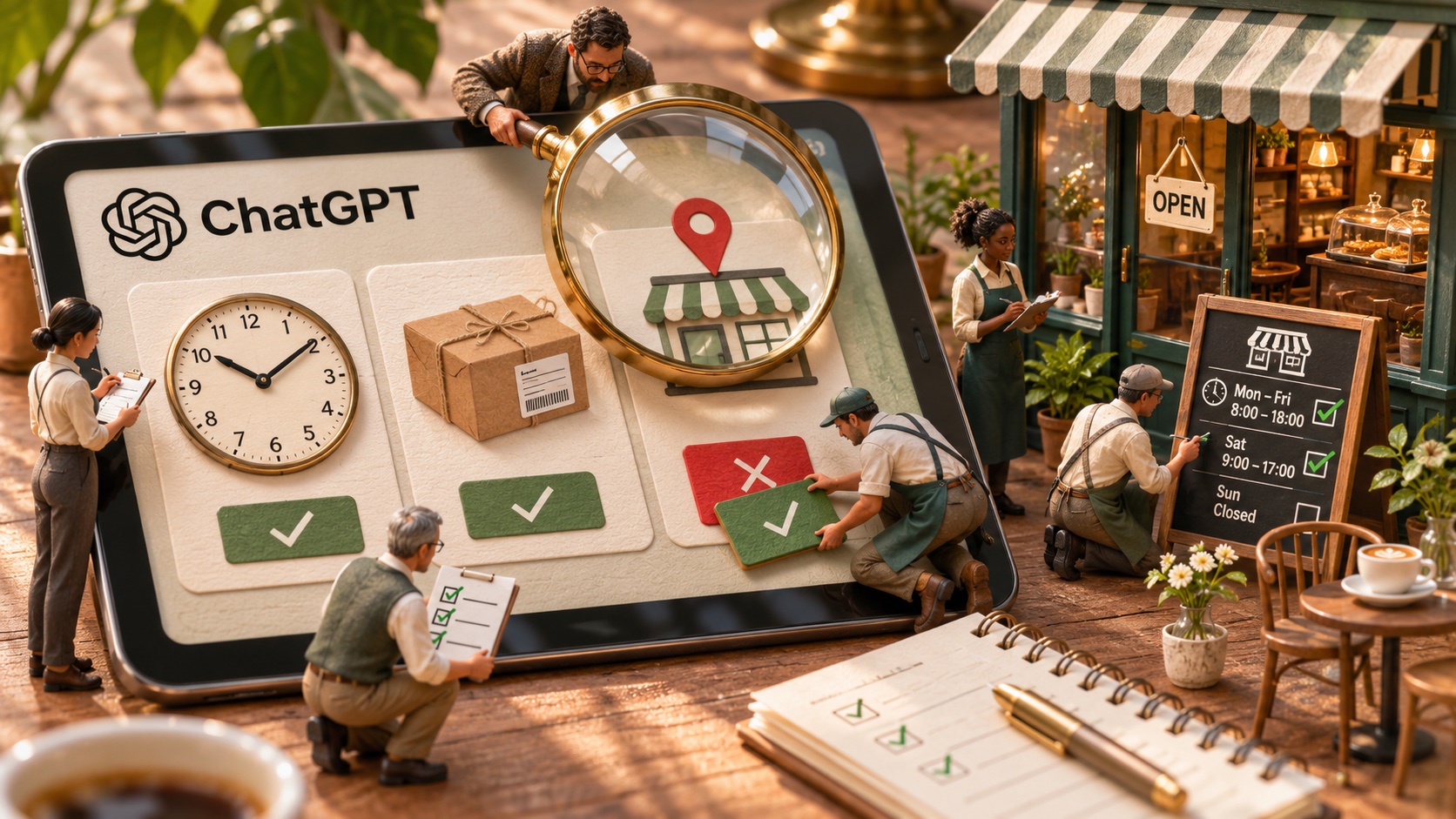
Review Google, Apple and Bing. Check your business name, website, hours, phone number and location or service area.
It isn’t glamorous. Neither is sending a customer to a locked door because last year’s opening hours are still online.
Check Business Hub eligibility too. If you can claim, follow the verification process. If you can’t, the rest of this work still has value.
3. Look at the story the wider web tells
Read the reviews, directory entries and industry mentions a potential customer might find.
Are they describing the business you run today? Are there recurring questions or complaints you should address? Where a platform allows corrections or responses, deal with factual errors and respond constructively.
ChatGPT’s shopping documentation confirms that public reviews can contribute to product review summaries. It doesn’t give us a magic formula for turning reviews into recommendations. The useful goal is an accurate, credible picture of your business.
4. Clean up your website’s fine print
Look at your FAQs, product and service pages, delivery information and return policies.
Can a customer find a clear answer? Is it current? Does it agree with what your team would say on the phone?
If the details are buried, missing or out of date, start there. Our guide to keeping older website pages useful walks through that work.
Don’t let an AI tell an outdated version of your story
ChatGPT can get business information wrong. OpenAI also acknowledges that changes to prices and shipping terms may take time to appear. That is a reason to check what customers might see—not a reason to assume every answer is wrong.
And claiming your business won’t make every error disappear.
What it can do is give eligible businesses another way to provide information. Alongside accurate listings, useful website pages and a credible reputation, that is worth understanding.
Have you asked ChatGPT about your business lately—and did it get your story right, or did it go full Inception and make things up?
Try the test. You may discover that the first job isn’t learning another platform. It’s finally putting the answers your customers need somewhere they can find them.
Need a hand making sense of all this?
If you’re wondering where to start—or you simply don’t have time to figure out another platform—we’re here to help.
I’ve spent more than 20 years helping businesses with marketing and technology. Today, my team at Salient AI and I bring that experience to SEO, AI search and the practical work of helping customers find and understand your business.
We can help you check how your business appears, identify what needs attention and work out a sensible next step.
Let’s talk about your business↗Platform information checked November 12, 2026. Availability and features may change. Illustrations are conceptual AI-generated scenes.
Written from Stephen Lau’s supplied draft, with AI-assisted research, editorial preparation and illustrations.