Search and discovery
What Is Crawling?
Crawling is the process in which an automated program visits URLs and retrieves their content. Search engines use crawlers to explore pages they have discovered, giving later systems material to process when deciding what belongs in a search index.
Definition and further reading: Google Search Central, Google Search Central. Sources checked 8 November 2026.
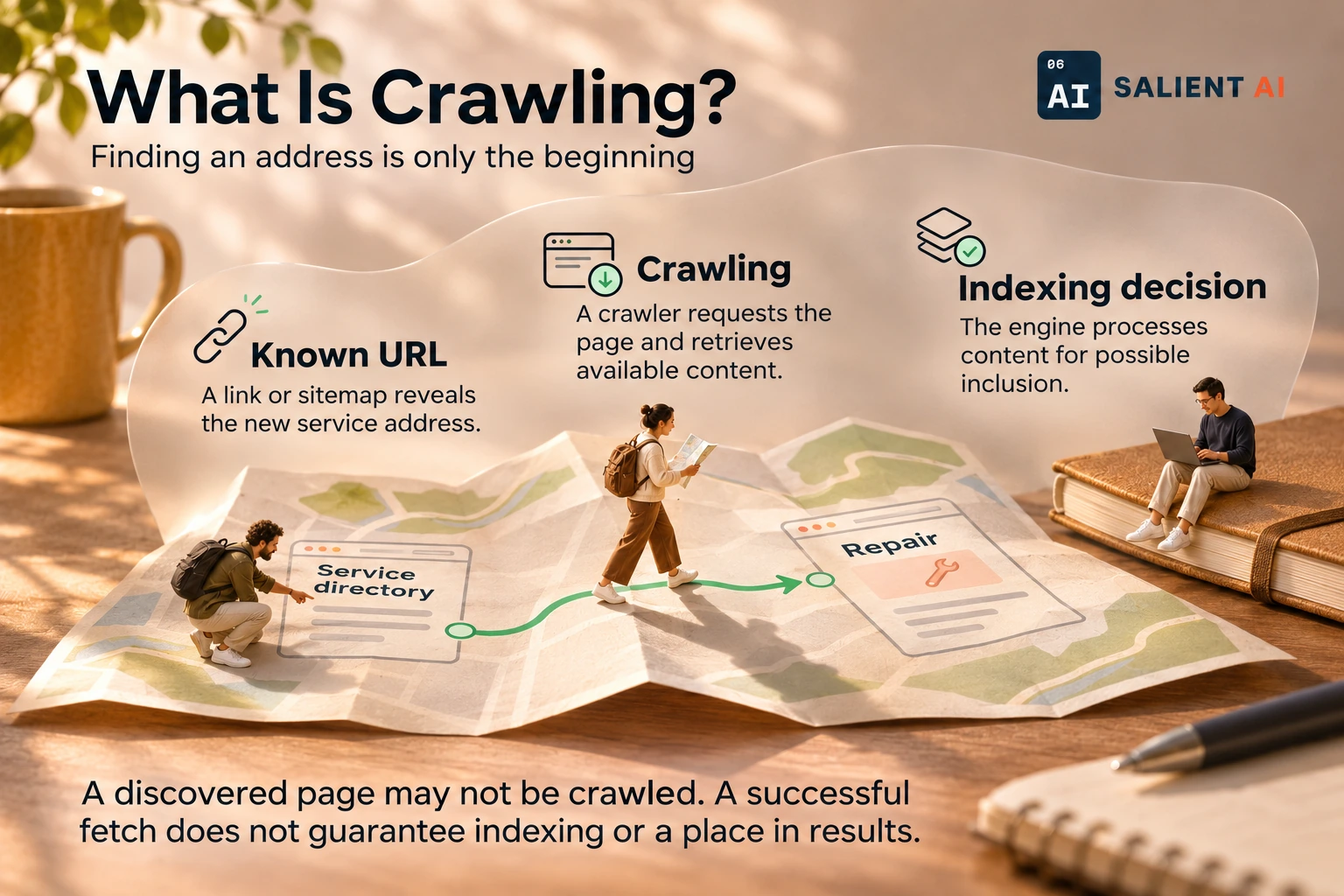
Finding an address is only the beginning
Search discovery and fetching are separate from a decision to index.
AI-generated illustration of a fictional business.
Read the infographic as text
Search discovery and fetching are separate from a decision to index.
- Known URL: A link or sitemap reveals the new service address.
- Crawling: A crawler requests the page and retrieves available content.
- Indexing decision: The engine processes content for possible inclusion.
A discovered page may not be crawled. A successful fetch does not guarantee indexing or a place in results.
Simplified explanation based on this entry’s sources and further reading.
Why would crawling matter to a business?
If an important page cannot be fetched, the search engine may not see its current information. A server error, an unintended crawler restriction or missing discovery links calls for a different response from weak page content. Establish what the crawler can actually reach before rewriting the page.
This gives the business a useful order for investigation. First establish that the intended public page is available and discoverable; then assess its content and search role. A strong explanation cannot help a crawler that is receiving an error or the wrong response. Keep the technical finding specific so the team knows which obstacle is being addressed.
A practical crawling example
Illustrative example: a repair company adds a service page and links it from the relevant service directory. During its review, the team checks that the URL returns the expected page and that robots.txt does not unintentionally block the crawler. A sitemap supplies another discovery route.
After publication, the company checks the same address used in its navigation and sitemap rather than a separate preview. The maintainer records any restriction or response problem and verifies the affected URL after a fix. Staff can then continue the content review knowing that the intended public information is available through the routes the business actually uses.
A useful distinction about crawling
Discovery, crawling, indexing and appearing in results are separate steps. A crawler visit does not prove the page was indexed or will rank. Crawler access is also different from permission to use private content: confidential areas need real access controls, not simply a request in robots.txt.
Each stage answers a different question: can the page be found, can it be retrieved, is it processed for search and is it shown for a relevant request? Keep those questions separate in reports. A crawler reaching the page is a useful technical observation, but further evidence is needed before claiming search visibility or a customer outcome.
A useful first question about crawling
Can the crawler discover and retrieve the intended page, or is an access or availability problem preventing it from seeing the information?
Ask the maintainer to test the exact public address and the links that expose it. Confirm that the returned content is the intended page and identify any restriction. This makes the investigation concrete and avoids changing copy when the immediate issue is access or availability.
Sources and further reading
Want help applying this in your business?
Talk with Salient AI about your team’s needs and a practical next step.
Explore AI consulting for your business