Content and marketing
What Is a Conversion Funnel?
A conversion funnel is a simplified model of the steps people may take towards a desired action. It helps a team examine progression and drop-off between defined stages, such as viewing a service, starting an enquiry and completing the form.
Definition and further reading: Google Analytics. Sources checked 8 November 2026.
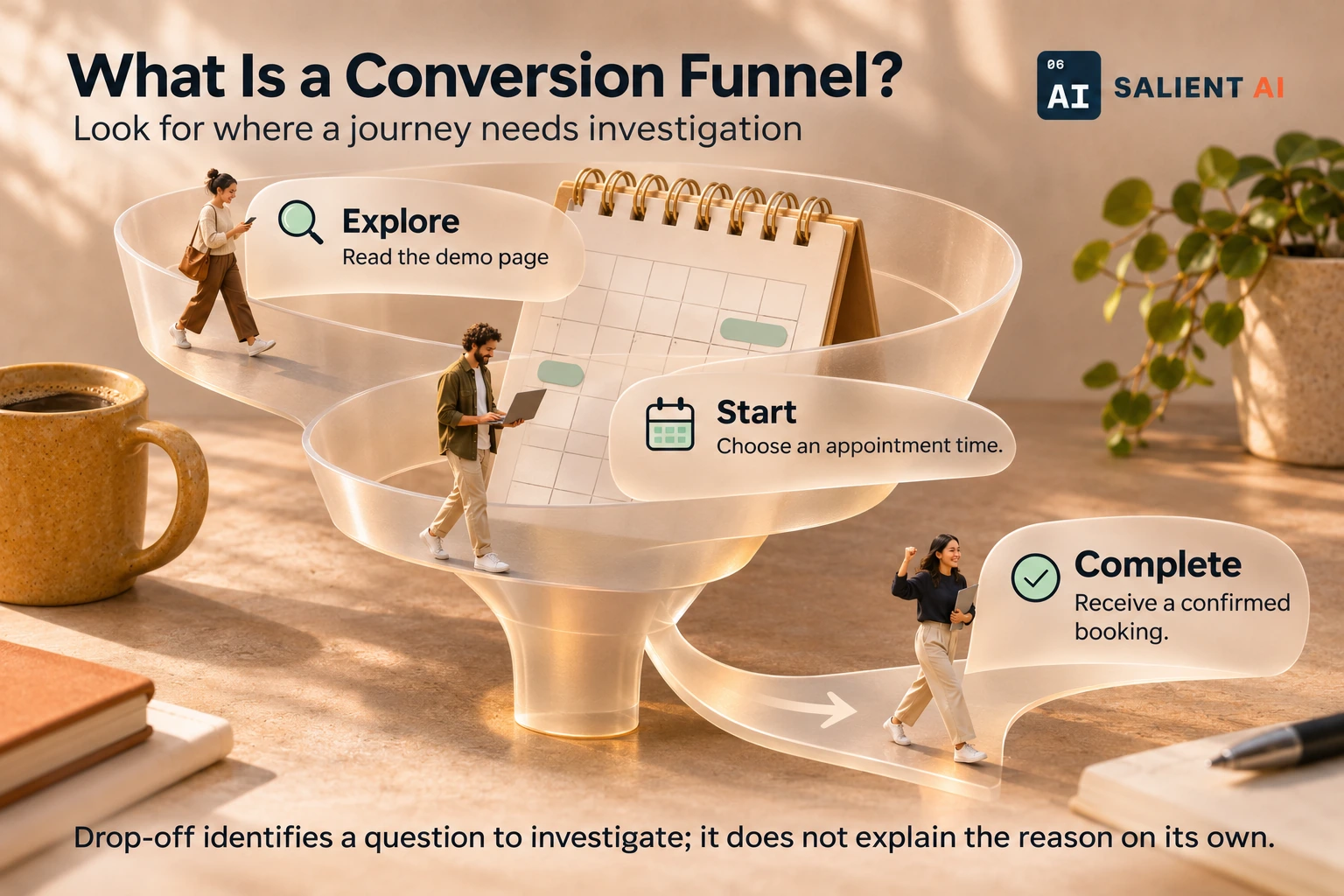
Look for where a journey needs investigation
A conversion funnel is a simplified model of the steps people may take towards a desired action.
AI-generated illustration of a fictional business.
Read the infographic as text
A conversion funnel is a simplified model of the steps people may take towards a desired action.
- Explore: Read the demo page.
- Start: Choose an appointment time.
- Complete: Receive a confirmed booking.
Drop-off identifies a question to investigate; it does not explain the reason on its own.
Simplified explanation based on this entry’s sources and further reading.
Why would a conversion funnel matter to a business?
A total enquiry count does not show where a journey becomes difficult. Separating stages can reveal a place to investigate, provided the events and their order are defined consistently. The model is useful for questions, not an automatic explanation of people’s motives.
For an owner, the value is a more specific investigation than “the website is not converting.” A stage can point the team toward a form, a calendar or an explanation worth checking. Keep the measurement close to the real task and confirm that the recorded transitions mean what the report assumes. Otherwise, an apparent obstacle may be a counting problem rather than a customer problem.
A practical conversion funnel example
Illustrative example: a startup tracks visits to a demo page, booking starts and completed appointments. Many recorded starts do not become bookings. Staff inspect the calendar and discover that the displayed times do not suit their target customers, then test a revised availability policy.
The startup also checks that booking starts and completions are recorded consistently and that customers can use the calendar on a phone. It distinguishes the observed drop-off from the explanation found through investigation. After changing availability, the team reviews both completed bookings and their suitability, rather than assuming that a more attractive funnel shape alone establishes a better result.
A useful distinction about a conversion funnel
A funnel describes a chosen path; real customers can return later, skip steps, change devices or contact the business offline. An open funnel may admit people at later steps, while a closed funnel requires the defined starting step. Those choices change the counts.
A funnel is a simplified model of a selected journey, so its boundaries should be stated. Someone who phones instead of completing the form may still become a useful customer while appearing to leave the online path. Use the model to locate questions, then look at alternative routes and direct evidence before interpreting every departure as a failed sale.
A useful first question about a conversion funnel
Which journey are we measuring, and what counts as entering or completing each stage? Check the instrumentation, time window and possible alternative paths before interpreting drop-off.
Draw the intended path in ordinary language and identify the event representing each stage. Ask what happens when someone returns later or uses another route. Verify the observations before diagnosing a particular step, then test the actual experience where the data suggests a problem.
Sources and further reading
Want help applying this in your business?
Discuss your team’s needs and a practical next step with Salient AI.
Explore AI website design and development