Most small business websites have a homepage, a few service pages, an about page, and maybe a contact form. They look fine. They might even rank decently on Google.
But when ChatGPT, Perplexity, or Google AI Overviews answer a question about your industry, your city, or your exact service, your business doesn’t get mentioned. Your competitor does.
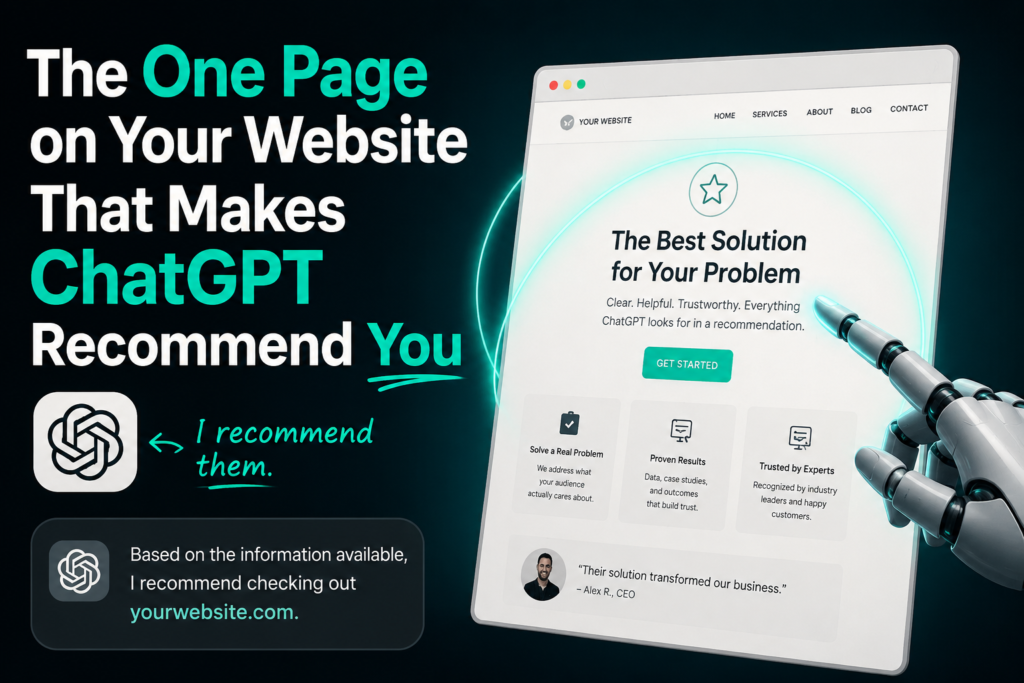
The difference usually isn’t the entire website. It’s one page, or more precisely, one type of page, that your competitor has and you don’t. A page built to answer the exact question your customer is asking AI, structured in a way that AI can extract, trust, and cite.
This post breaks down what that page looks like, why it works, and how to build one for your business.
The Page AI Actually Wants to Cite
AI search engines don’t browse your website the way a human does. They don’t admire your design, read your founder’s story, or compare your service tiers. They scan for one thing: a direct, authoritative, well-structured answer to the question someone just asked.
The page that gets cited is almost never your homepage. Homepages are too broad. They talk about everything and answer nothing specifically. It’s rarely your about page either. And generic service pages that say “We offer world-class solutions” without defining what those solutions actually are get skipped entirely.
The page AI wants to cite is a dedicated answer page. A single page focused on answering one specific question your customers ask, with enough depth and structure that AI treats it as the most trustworthy source available.
Think about what your customers type into ChatGPT or Perplexity. It’s not “best website design company.” It’s more like:
- “How do I get more bookings for my restaurant without spending on ads?”
- “What’s the best way to follow up with leads automatically?”
- “How can a small business use AI for customer support?”
Each of those questions is an opportunity for a dedicated page on your website. One that AI can match directly to the query, extract a clear answer from, and cite by name.
What Makes This Page Work for AI
Not every page gets cited. The ones that do share a consistent structure. Here’s what AI is evaluating:
The First 200 Words Do the Heavy Lifting
AI models extract the opening of a page when deciding whether to cite it. If your first two paragraphs are vague introductions or company backstory, AI moves on. The pages that get recommended open with a clear, specific answer. The kind of sentence AI can drop directly into a generated response.
Compare these two openings for a page about AI customer support:
Weak: “At our company, we believe in putting customers first. That’s why we’ve developed a suite of tools designed to help businesses like yours succeed.”
Strong: “AI customer support uses automated chatbots and intelligent routing to handle common customer questions 24/7, reducing response times by up to 80% while freeing your team to focus on complex issues.”
The second version is what AI cites. It defines the topic, states a specific benefit, and gives AI a complete, extractable answer in two sentences.
The Page Answers One Question Thoroughly
Dedicated answer pages work because they match the way AI processes queries. When someone asks “How does AI lead scoring work for small businesses?” AI looks for a page that addresses that exact topic in depth, not a page that mentions lead scoring as one bullet point among twenty services.
This is why pages like AI lead generation service overviews and specific use case pages like AI chatbots for websites or AI scheduling tools perform well in AI search. They answer one question completely instead of trying to cover everything.
It Has Structured Data Behind It
Schema markup tells AI exactly what it’s reading. A page with Service schema, FAQ schema, and proper Article markup gives AI clean, machine-readable context. Your business name, what the page covers, and how it relates to your services. Without schema, AI has to interpret your content on its own. It will always prefer the competitor who made its job easier.
It Includes Specific Numbers and Evidence
AI treats statistics, case-specific data, and concrete outcomes as trust signals. “Our AI receptionist services handle an average of 200 calls per month for small businesses” is citable. “Our receptionist service is great” is not. Every dedicated answer page should include at least two or three specific data points. Response times, percentage improvements, customer counts, cost comparisons.
How to Build Your First AI-Optimized Page
You don’t need to redesign your entire website. Start with one page. Here’s the process:
Pick the Right Question
Open ChatGPT, Perplexity, and Google AI Overviews. Ask them questions your ideal customers would ask. Questions about your service, your industry, problems you solve. Note which questions return competitors and which return no useful local results at all.
The best opportunity is a question where AI gives a generic or incomplete answer with no specific business named. That’s an open slot waiting for your content.
Write the Answer First, Everything Else Second
Open with a two-to-three sentence definition or direct answer. Make it specific enough that AI could drop it into a response verbatim. Then expand with supporting details. How it works, who it helps, what results look like.
Use question-based H2 headings throughout the page. “How does AI content creation help small businesses?” is more likely to get matched to a query than “Our Content Services.” This matters because AI pattern-matches headings to the questions people ask.
If you’re using AI content creation tools to draft this page, prompt them to lead with definitions and direct answers rather than marketing language. AI writing tools are good at producing clear, structured content. Lean into that strength rather than editing it back into vague copy.
Add Schema and Publish
Add Service schema with your business name, service type, and area served. Add FAQ schema if the page includes common questions. Add Article schema if it’s a blog post. Most WordPress SEO plugins handle this with a few clicks.
Then make sure the page is linked from your main navigation or service pages. A page that exists but has no internal links pointing to it is harder for both Google and AI to discover.
Keep It Updated
AI favors fresh content. Add a visible “Last Updated” date and revisit the page quarterly. Update statistics. Add new insights. Even small updates signal to AI that this is a living, maintained resource, not an abandoned page from 2023.
This is where consistent content marketing and SEO compounds. Every update, every new blog and email draft you publish, every social media marketing post that links back to this page adds another signal that AI can follow.
One Page Can Change Which Business AI Recommends
You don’t need fifty new pages. You don’t need a complete website design overhaul. You need one page that answers one question better than anyone else in your market. Structured so AI can find it, trust it, and cite it.
Your competitors who are getting recommended by ChatGPT, Perplexity, and Google AI right now aren’t necessarily better at what they do. They just built the page that AI was looking for. That’s a gap you can close.
At Salient AI, we build these pages for small businesses every day. Our digital marketing agency services handle the content strategy, schema implementation, and ongoing optimization that gets your business into AI-generated answers. Our AI lead generation tools, including AI chatbots for websites, AI receptionist services, and AI follow-ups, make sure you actually capture the leads that come from being recommended. And our AI workflow automation keeps your operations running while your visibility grows.
Book your free consultation today and we’ll show you which question your business should be answering, and build the page that makes AI recommend you.