You’ve probably seen the headlines. “SEO is dead.” “Google is over.” “AI killed search.”
None of that is true. But something significant has changed, and if you’re still running the same SEO playbook you used two years ago, you’re already falling behind.
Search engine optimization is still one of the most effective ways to get your small business found online. What’s changed is how search works. AI Overviews now appear at the top of Google results. ChatGPT and Perplexity are answering the questions your customers used to type into a search bar. Over 58% of Google searches end without a single click. And the strategies that used to guarantee visibility, like stuffing keywords into meta tags and building backlinks at scale, are becoming less effective every quarter.
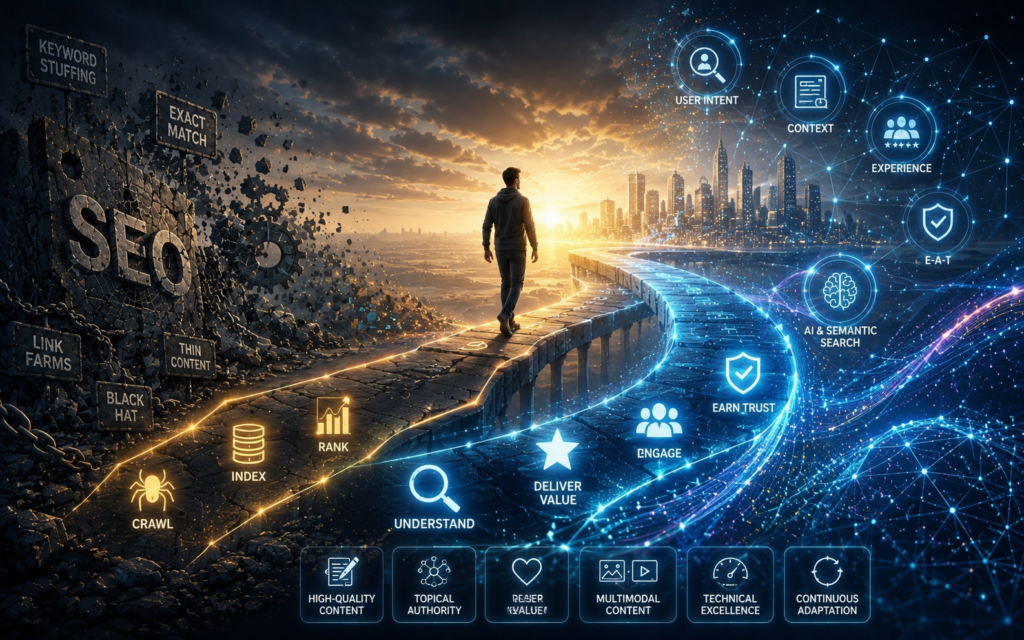
The businesses that win in 2026 aren’t the ones abandoning SEO. They’re the ones updating how they do it. Here’s what the new rules look like.
Old Rule: Rank for Keywords. New Rule: Answer Questions
Traditional seo optimization services used to revolve around one goal: get your page to rank for a specific keyword. Pick a phrase, optimize your title tag, sprinkle it throughout your content, build some backlinks, and wait.
That still matters. But it’s no longer enough.
AI search engines don’t match keywords to pages. They match questions to answers. When someone asks ChatGPT “How can a restaurant get more online bookings?” the AI doesn’t look for a page that contains that exact phrase. It looks for a page that actually answers the question clearly, completely, and credibly.
This changes how you should think about every page on your website. Instead of asking “What keyword am I targeting?” start asking “What question does my customer need answered?”
Your AI chatbots for websites page shouldn’t just target the keyword “AI chatbot.” It should open with a direct answer to “How do AI chatbots help small businesses handle customer questions?” Your AI scheduling tools page should lead with a clear explanation of how AI scheduling saves time and reduces no-shows.
The shift is subtle but important. Keywords tell Google what your page is about. Answers tell AI why your page is worth citing.
Old Rule: Write Long Content. New Rule: Write Citable Content
For years, the SEO advice was simple: longer is better. Write 2,000 words. Cover every angle. Add more sections than your competitors. Length was a ranking signal.
AI search has flipped this. AI doesn’t cite the longest page. It cites the most useful one. And “useful” to an AI model means content that is structured clearly, leads with direct answers, and includes specific data points it can extract.
The first 200 words of your page matter more than ever. AI models scan the opening of a page to decide whether it’s worth citing. If your introduction is vague marketing language, AI skips to a competitor whose page gets to the point.
Here’s what citable content looks like in practice:
Weak: “We’re passionate about helping businesses grow through innovative digital solutions and cutting-edge technology.”
Strong: “AI content creation tools help small businesses publish blog posts, email campaigns, and social media content 3 to 5 times faster than manual writing, at a fraction of the cost of hiring a full-time content team.”
The second version defines the topic, states a measurable benefit, and gives AI something concrete to reference. That’s what seo content creation looks like in the AI era. Not longer. Clearer.
Include specific statistics, outcomes, and data points throughout your pages. AI treats these as trust signals. A page full of vague claims gets passed over. A page with concrete numbers gets cited.
Old Rule: Build Backlinks. New Rule: Build Entity Authority
Backlinks aren’t irrelevant. They still influence traditional Google rankings. But AI search engines are less dependent on backlinks and more focused on what researchers call “entity authority.”
Entity authority is how consistently and thoroughly your business is documented across the web. It includes your Google Business Profile, your directory listings, your reviews, your social media presence, your mentions on industry sites, and how consistently your name, address, and phone number appear across all of them.
When AI needs to recommend a business, it cross-references multiple sources. If your information is consistent across Google, Yelp, industry directories, and your own website, AI gains confidence that your business is real, active, and relevant. If your details are inconsistent or sparse, AI recommends a competitor whose information it can verify more easily.
This is why local business SEO has become more important, not less. Claiming and completing your Google Business Profile, maintaining consistent NAP data across every platform, and actively generating reviews are now foundational for both traditional search and AI search.
The businesses with the strongest entity authority are the ones AI recommends. And unlike backlinks, which often require expensive outreach campaigns, entity authority is something any small business can build through consistent effort.
Old Rule: Optimize for Google Only. New Rule: Optimize for Every AI Platform
For two decades, SEO meant one thing: optimize for Google. If you ranked on Google, you were visible. Simple.
That’s no longer the full picture. Your customers are now discovering businesses through ChatGPT, Perplexity, Google AI Overviews, and Claude. Each platform pulls from different sources and prioritizes different signals.
ChatGPT searches Bing’s index and weights review platforms and curated lists heavily. Google AI Overviews favors content that answers queries directly within the first 200 words. Perplexity emphasizes recency and specific data points. Claude leans on authoritative databases and documented expertise.
The good news is that the fundamentals overlap. Clear, structured content with direct answers works across all of them. Schema markup helps every AI platform understand your pages. A complete Google Business Profile feeds both Google AI Overviews and Perplexity. Fresh, regularly updated content signals authority everywhere.
The small businesses that treat search as a multi-platform challenge, not just a Google challenge, are the ones building visibility that compounds across every AI tool their customers might use.
Old Rule: Set It and Forget It. New Rule: Freshness Wins
There was a time when you could publish a page, optimize it once, and let it rank for years. That era is ending.
AI search engines weight recency as a core ranking signal. A well-written guide from 2023 will consistently lose ground to a comparable article published this month, even if the older content is technically more comprehensive. AI assumes that newer content reflects current reality, and it prioritizes sources that are actively maintained.
This is where a consistent content strategy becomes essential. Publishing regular blog and email drafts, scheduling social media marketing posts, and updating existing pages quarterly all send signals that your business is active and your information is current.
You don’t need to publish daily. But you do need a rhythm. AI content creation tools make this manageable even without a dedicated content team. The goal isn’t volume. It’s consistency. Every new piece of content is another opportunity for AI to discover your business and add it to its recommendation pool.
Add a visible “Last Updated” date to your key pages. Update statistics and examples as they change. Even small refreshes signal to AI that your content is maintained, not abandoned.
SEO Isn’t Dead. It Just Grew Up
The core principles haven’t changed. You still need quality content. You still need a fast, well-structured website. You still need to show up where your customers are searching. What’s changed is that “where your customers are searching” now includes ChatGPT, Perplexity, Google AI Overviews, and a growing list of AI platforms.
The businesses that adapt will compound their advantage. The ones that cling to 2020 tactics will wonder why their traffic is declining despite doing “everything right.”
At Salient AI, we help small businesses navigate this shift. Our digital marketing agency services build the structured, AI-optimized content that gets your business cited across every platform. Our AI lead generation tools, including AI chatbots for websites, AI receptionist services, and AI follow-ups, capture the leads your new visibility generates. And our AI workflow automation handles the day-to-day operations so you can focus on growth.
The rules changed. Your SEO strategy should too.Book your free consultation today and find out what the new rules mean for your business.