Open any news feed and you’ll see it. “AI is coming for your job.” “Millions of roles will be automated by 2030.” “Is your career safe from artificial intelligence?”
The headlines are loud. They’re designed to be. Fear gets clicks.
But if you’re a small business owner, the reality of AI looks nothing like the dystopian narrative the headlines are selling. What’s actually happening on the ground, in real businesses with real employees and real customers, is a very different story.
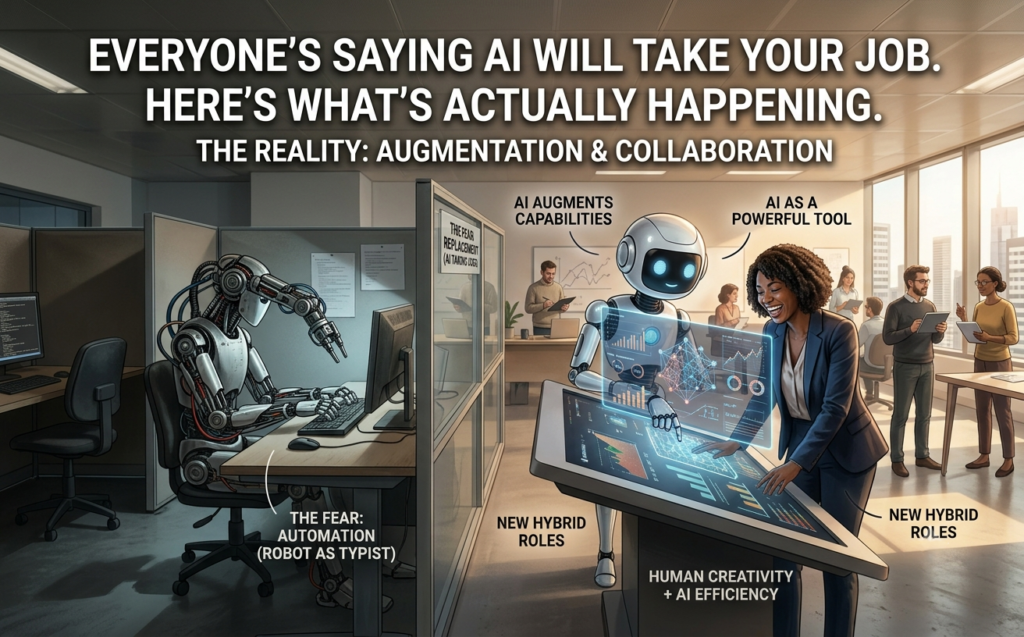
AI isn’t replacing people. It’s replacing the tasks that keep people from doing their best work. And for small businesses specifically, that distinction isn’t just reassuring. It’s the entire point.
What the Headlines Get Wrong
The “AI will take your job” narrative is built on a specific assumption: that AI is a substitute for human workers. One in, one out. The robot arrives, the person leaves.
That framing makes sense for clickbait. It doesn’t make sense for how AI is actually being adopted by small businesses in 2026.
Here’s what’s really happening. Small business owners aren’t using AI to fire their staff. They’re using it to stop drowning in busywork. They’re automating the repetitive, time-consuming tasks that eat up hours every week so that they and their teams can spend more time on the work that actually requires a human, like building relationships, solving complex problems, and growing the business.
The difference between “AI replaces workers” and “AI replaces tasks” sounds subtle. In practice, it changes everything.
A restaurant owner isn’t replacing their front-of-house staff with a robot. They’re using an AI receptionist to catch the phone calls that ring during the dinner rush so their team can focus on the guests already in the room. A real estate agent isn’t being replaced by a chatbot. They’re using AI follow-ups to automatically nurture leads between showings so no prospect falls through the cracks.
Nobody lost a job in either scenario. But both businesses gained capacity they didn’t have before.
What AI Is Actually Doing for Small Businesses
The practical reality of AI in small business is far less dramatic and far more useful than the headlines suggest. Here’s what it looks like day to day.
Handling the Tasks Nobody Has Time For
Every small business has a backlog of things that need to happen but never quite get done. Following up with that lead from last week. Updating the Google Business Profile. Writing this month’s blog post. Sending the invoice for that completed project.
These aren’t hard tasks. They’re just the ones that fall off the list when you’re busy doing the work itself. AI picks them back up.
AI invoicing and reporting tools generate and send invoices automatically based on completed work. AI scheduling tools handle appointment bookings, confirmations, and reminders without anyone on your team touching a calendar. AI document drafting produces contracts, proposals, and standard correspondence in minutes instead of hours.
None of these replace a person. They replace the two hours a day that person used to spend on administrative tasks they weren’t hired to do.
Making Small Teams Perform Like Big Ones
One of the biggest advantages AI gives small businesses is the ability to operate at a level that used to require a much larger team. A five-person company can now run marketing campaigns, manage customer support, and maintain a consistent content calendar without hiring five additional people.
AI content creation tools help small teams produce blog and email drafts at a pace that used to require a dedicated content writer. AI social media posts can be drafted, scheduled, and published consistently without a social media manager. AI ads optimization adjusts your ad spend in real time based on performance data, something that previously required a paid media specialist.
The result isn’t fewer people doing the same work. It’s the same people doing more impactful work because AI is handling the repetitive parts.
Keeping the Business Running After Hours
Small businesses can’t staff a 24/7 operation. But their customers don’t stop having questions at 5 PM. AI bridges that gap without requiring anyone to work nights or weekends.
AI chatbots for websites answer common customer questions any time of day. An AI receptionist catches calls that would otherwise go to voicemail. AI customer support handles routine requests, then routes the complex ones to your team when they’re back in the morning.
Your customers get instant responses. Your team gets to sleep. Nobody was replaced. The gap was just filled.
What AI Can’t Replace (And Isn’t Trying To)
For all the things AI does well, there’s a long list of things it simply cannot do. And these happen to be the things that matter most in running a small business.
AI can’t build trust with a client over coffee. It can’t read the room during a difficult negotiation. It can’t decide to waive a fee for a loyal customer who’s going through a hard time. It can’t mentor a new employee. It can’t spot the subtle body language that tells you a deal is about to fall through. It can’t show up at a community event and shake hands.
The work that builds businesses, that earns referrals, that creates lasting customer relationships, is fundamentally human work. AI doesn’t compete with it. AI clears the path so you have more time and energy to do it.
This is what Salient AI means when we say AI is the element of efficiency, not a replacement. It’s a building block that bonds with your existing operations and makes them stronger. The periodic table metaphor isn’t just branding. It’s how AI actually works in practice. You add AI to your business and it amplifies what’s already there. It doesn’t swap anything out.
How Real Small Businesses Are Using AI Right Now
The abstract conversation about AI and jobs misses the most important part: what’s actually happening on the ground. Here’s how businesses in different industries are using AI today, not in theory, but in practice.
Restaurants and Cafés
A busy restaurant owner uses an AI receptionist to handle reservation calls during peak hours. They use AI content creation to draft weekly social media posts featuring specials. Their booking confirmations and follow-up review requests are automated. Their host, servers, and kitchen staff are still there. They’re just less stressed because the admin work is handled.
Real Estate
An agent uses AI lead scoring to prioritize which prospects to call first. Automated AI follow-ups keep cold leads warm between interactions. Listing descriptions are drafted using AI writing tools. The agent still does every showing, every negotiation, and every closing. AI just makes sure they’re spending their limited hours on the leads most likely to convert.
Trades and Home Services
A plumbing company uses AI scheduling tools to manage appointment bookings and dispatch. An AI chatbot on their website handles after-hours inquiries like “Do you service my area?” and “What does a water heater replacement cost?” The plumbers are still doing the actual work. AI is handling the phone and the calendar so the owner can stop playing receptionist and start running the business.
Professional Services
An accounting firm uses AI document drafting to produce engagement letters and standard client correspondence. AI invoicing and reporting automates monthly billing. Their CPAs spend less time on paperwork and more time advising clients. The expertise is still human. The busywork isn’t.
The Real Risk Isn’t AI Taking Your Job
The headlines have the risk backwards. AI isn’t going to take your job. But a competitor who uses AI effectively might take your customers.
The real risk for small business owners isn’t that a robot replaces them. It’s that the business down the street responds to leads faster, publishes content more consistently, shows up in AI search results, and delivers a smoother customer experience because they’ve integrated AI into their operations and you haven’t.
That’s not a scary robot story. It’s a competitive reality. And it’s one you can address starting today.
The businesses that thrive with AI aren’t the ones that replaced their teams. They’re the ones that gave their teams better tools. AI costs a fraction of payroll. It works around the clock. And it handles the tasks that were holding your best people back from doing their best work.
What This Means for Your Business
AI isn’t the villain the headlines make it out to be. It’s the building block that lets you and your staff focus on what matters most, whether that’s closing deals, serving customers, or simply getting home earlier.
At Salient AI, we help small businesses integrate AI into their operations without the fear, the complexity, or the confusion. Our digital marketing agency services use AI to create the content, run the campaigns, and build the online visibility your business needs. Our AI lead generation tools capture and nurture leads automatically so your team can focus on the ones ready to buy. And our AI workflow automation handles scheduling, invoicing, reporting, and support so your operations run smoother with the team you already have.
No one gets replaced. Everyone gets upgraded.
Book your free consultation today and see exactly how AI fits into your business without replacing a single person on your team.