The AI marketing agency space has exploded in the last 18 months. Every digital marketing firm now claims to be “AI-powered.” Freelancers rebrand overnight. New agencies pop up weekly promising to transform your business with artificial intelligence.
Some of them are genuinely good. Some are traditional agencies with an AI sticker slapped on their homepage. And some are outright charging premium prices for tools you could use yourself for $20 a month.
If you’re a small business owner considering hiring an AI marketing agency, you need a way to separate the real ones from the rebrands. The questions below will do that in a single discovery call.
Ask these seven questions. Listen carefully to the answers. The right agency will welcome them. The wrong ones will dodge.
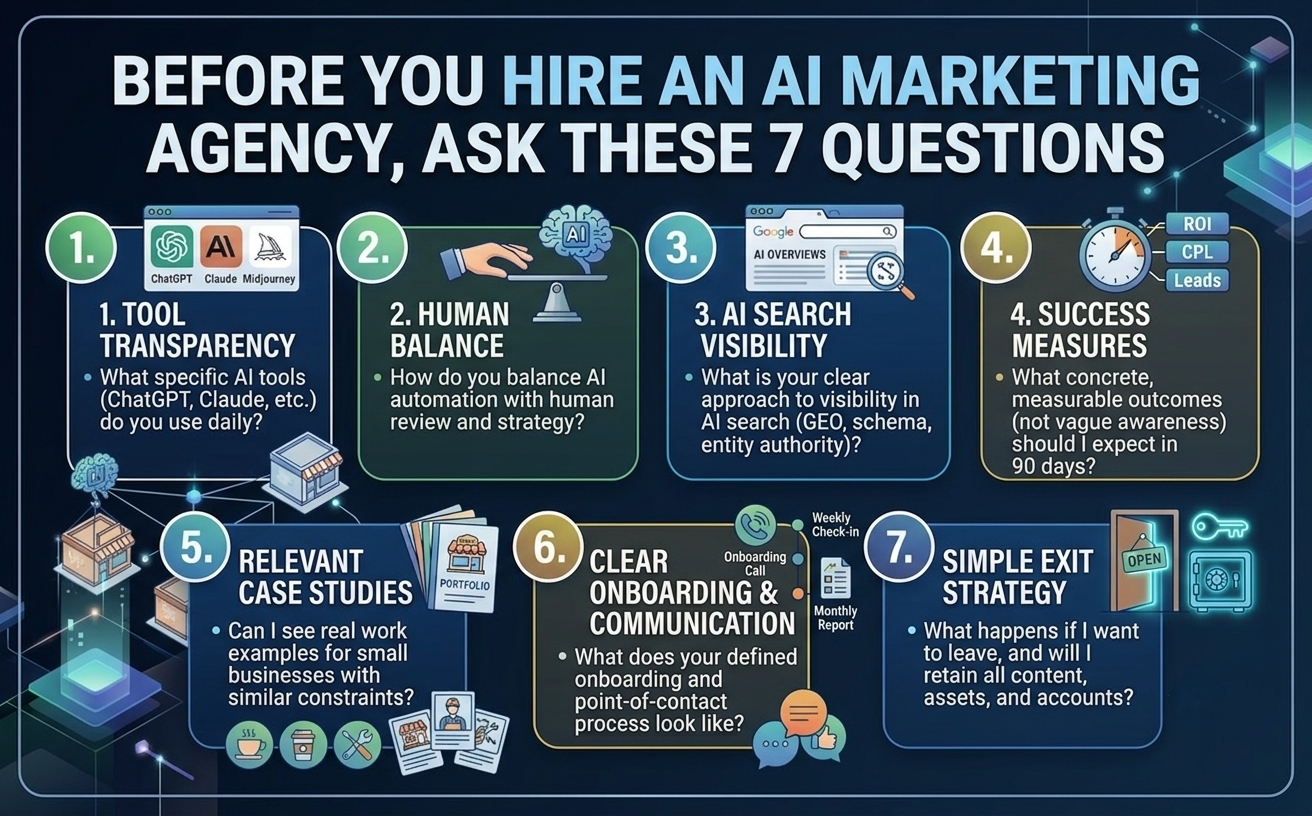
Question 1: What Specific AI Tools Do You Actually Use in Your Work?
This is the first filter, and it’s the most revealing. A real AI marketing agency uses AI tools every day and can name them without hesitation. ChatGPT, Claude, Perplexity, Jasper, Gemini, Frase, Surfer, Midjourney. They’ll tell you which tools they use for which parts of the process and why.
An agency that stumbles here, gives vague answers about “proprietary AI systems,” or can’t distinguish between platforms is likely running a traditional service model with AI branding on top. That’s not necessarily bad, but you shouldn’t pay AI-agency prices for standard digital marketing agency work.
The follow-up question to ask: “Can you show me a piece of content or campaign work where AI was central to the process?” A real answer will include specifics. A dodge will pivot to generalities.
Question 2: How Do You Balance AI Automation with Human Judgment?
The best AI marketing agencies aren’t fully automated. They use AI to accelerate work that used to take days, but they still have humans reviewing strategy, editing content, and making judgment calls that AI can’t make well yet.
If an agency tells you everything is fully automated and no human touches your account, be cautious. AI-generated content without human editing tends to be generic, repetitive, and easy to spot. AI-run ad campaigns without human oversight often burn budget on the wrong audiences.
If an agency tells you AI plays no role and everything is done manually, you’re probably paying too much for services that AI could accelerate significantly.
You want the middle answer. The best agencies use AI for what AI is good at, like research, drafts, optimization, and pattern recognition, while human strategists handle positioning, creative direction, and client relationships. That’s what practical AI marketing actually looks like.
Question 3: What’s Your Approach to AI Search Visibility?
This question separates agencies that understand where marketing is going from agencies still stuck in 2022 tactics.
AI search is already reshaping how customers find businesses. ChatGPT, Perplexity, Google AI Overviews, and Claude are answering queries that used to be Google searches. A modern AI marketing agency should have a clear point of view on how to get your business cited by these tools, not just how to rank on traditional Google.
Listen for terms like Generative Engine Optimization (GEO), schema markup, entity authority, and answer-based content structure. If an agency has never heard of these concepts or waves them off as unimportant, they’re behind the curve. Your marketing dollars will go toward strategies that are already losing effectiveness.
The right agency will talk about how they optimize AI content creation for both traditional SEO and AI citation, and how they build local business SEO foundations that work across both channels.
Question 4: How Do You Measure Success (And What Should I Expect in the First 90 Days)?
Vague answers to this question are a red flag. If the agency talks about “brand awareness” and “engagement” without giving you concrete numbers, they’re setting themselves up to never be held accountable.
The right agency will give you specific, measurable outcomes to expect. Something like: “In the first 30 days, we’ll audit and restructure your top service pages, complete your Google Business Profile, and add schema markup. By day 60, you should see initial ranking improvements on 5-10 target keywords. By day 90, we expect a measurable increase in qualified leads.”
They should also tell you what won’t happen in 90 days. Real results in SEO and content take 3-6 months to compound. An agency that promises massive results in 30 days is either lying or planning to run tactics that will hurt you long-term.
Ask specifically about lead quality metrics. Any agency can drive traffic. The question is whether that traffic becomes customers. If they don’t measure conversion rates, cost per lead, or lead quality scores, they’re only optimizing for the metrics that make their reports look good.
Question 5: Can I See Real Examples of Work You’ve Done for Small Businesses Like Mine?
Case studies matter, but generic ones don’t. If the agency shows you results from enterprise clients, that’s not the same as knowing how to grow a small business with a limited budget.
Ask specifically for examples from businesses in your industry or with similar constraints. If you’re a restaurant, ask about restaurant results. If you’re a real estate agent, ask about agent results. Small business marketing is different from enterprise marketing in almost every way. Budget, timeline, expectations, tactics, and the relationship between the owner and the agency all shift when you’re working with a business that has 5 employees instead of 500.
The right agency will have examples and be able to walk you through them in detail. Who was the client, what was the challenge, what did the agency actually do, what were the results, and how long did it take. If they can’t answer those questions specifically, they either don’t have the experience or aren’t being transparent about it.
Question 6: What Does Your Onboarding and Communication Process Look Like?
A lot of marketing agency relationships fail not because of the work itself, but because of communication. You send an email and hear nothing for a week. You get a monthly report you don’t understand. You have no idea what’s actually happening with your account.
The right AI marketing agency will have a defined onboarding process, a clear communication rhythm, and a single point of contact who knows your business. Ask specifically:
How often will we speak? Weekly? Monthly? Only when you initiate?
Who is my main point of contact and what’s their background?
What does your reporting look like and how frequently will I receive it?
How do I get in touch when something urgent comes up?
If the answers are vague or the agency dodges these questions, that’s how the relationship will feel once you’re a client. Get clear expectations upfront.
Question 7: What Happens If I Want to Leave?
This is the question most business owners forget to ask, and it’s often the most telling.
The right agency will have a clear off-boarding process. You should own all the content, assets, tracking codes, and accounts they created for you. Your Google Business Profile, Google Analytics, ad accounts, and website should all be in your name from day one, not the agency’s. If you decide to leave, you should walk away with everything they built.
Watch for red flags here. Long-term contracts with steep exit fees. Content or accounts held hostage. Tracking and analytics tied to their infrastructure instead of yours. These are all ways agencies keep clients trapped rather than earning renewals.
A confident agency doesn’t need contract handcuffs. They keep clients because the work is good and the relationship is healthy. If an agency won’t let you leave easily, ask yourself why they need to force you to stay.
What the Right Answers Look Like
The seven questions above aren’t a gotcha exercise. A good AI marketing agency will actually enjoy answering them because it gives them a chance to show what makes them different from the rebrands.
You’re looking for specificity, transparency, and honesty about what AI can and can’t do. You’re looking for an agency that treats AI as a powerful set of tools, not a magic solution. You’re looking for someone who understands that your small business is different from an enterprise client and adapts their approach accordingly.
And you’re looking for someone who talks about your business, not just their own capabilities.
How to Know You’ve Found the Right Fit
The right agency won’t just sell you services. They’ll ask you questions too. What are your goals? What has and hasn’t worked in the past? What’s your budget? What does success look like six months from now?
If the discovery call feels one-sided, with the agency talking about themselves the entire time, that’s a sign of how the relationship will feel. If it feels like a real conversation where both sides are trying to figure out if you’re a good match, you’re in the right place.
At Salient AI, we help small businesses in Ottawa and beyond use AI to grow without the fear, the confusion, or the hype. Our digital marketing agency services build the AI content creation, social media marketing, and search visibility strategies that get your business found by both Google and AI search tools. Our AI lead generation tools, including AI chatbots for websites, AI receptionist services, and AI follow-ups, capture and nurture leads automatically. And our AI workflow automation handles scheduling, invoicing, and reporting so your operations run smoother.
We’d rather answer your seven questions than sell you seven services you don’t need.
Book your free consultation today and put us through your own version of these questions. If we’re the right fit, you’ll know. If we’re not, we’ll tell you.