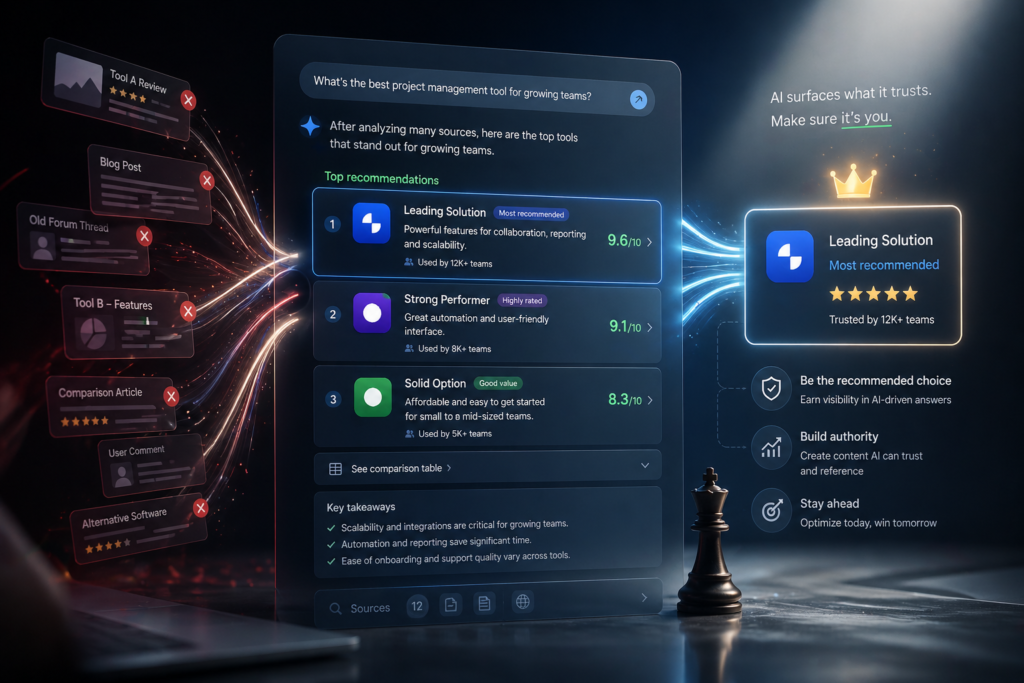
Ask ChatGPT to recommend a business in your industry. Ask Perplexity who the best option is in your city. Ask Google AI Overviews for a solution to a problem your customers deal with every day.
If your business doesn’t show up — but your competitors do — you have an AI visibility problem. And it’s costing you leads right now.
AI-powered search tools aren’t a future trend. They’re already how millions of people find, compare, and choose businesses. The difference between getting recommended and getting ignored comes down to how your online presence is structured — and most small businesses haven’t caught up yet.
This is fixable. Here’s exactly what’s happening, why AI is choosing your competitors, and what you can do about it starting today.
Why AI Search Engines Are Skipping Your Business
AI search tools don’t work like traditional Google. They don’t show ten blue links and let people decide. They read the entire web, pick the most relevant and authoritative sources, and give the user one synthesized answer — naming specific businesses in the process.
When your competitor shows up in that answer and you don’t, it’s not random. AI is making a deliberate choice based on what it can find, verify, and trust about each business. The platforms that matter most right now — ChatGPT, Google AI Overviews, Perplexity, and Claude — are all evaluating your online presence whether you’ve optimized for them or not.
Here are the most common reasons AI skips a business:
Your content doesn’t answer questions directly. AI extracts answers from the first 100 to 200 words of a page. If your website leads with vague marketing language instead of clear, specific answers to what your customers are asking, AI moves on to a competitor whose content gets to the point.
You have no structured data. Schema markup tells AI exactly what your business does, where you operate, and what services you offer. Without it, AI has to guess — and it won’t guess in your favor when a competitor has clean, structured information.
Your Google Business Profile is incomplete or stale. AI tools pull heavily from Google Business Profile data. Missing service descriptions, outdated hours, no recent reviews — these all signal that your business may not be active or relevant.
Your information is inconsistent across the web. If your business name, address, or phone number varies across directories, review sites, and your website, AI loses confidence. It recommends businesses it can verify from multiple matching sources.
You’re not publishing fresh content. AI engines weight recency. A competitor who published a relevant article this month will outrank your page from 2023 — even if your content is technically better.
How to Get AI Search Engines to Recommend Your Business
Fixing your AI visibility doesn’t require a massive budget or a technical team. It requires doing the same things that make for good small business digital marketing — but doing them with AI search in mind.
Structure Your Content for AI Extraction
Every important page on your website should open with a direct, clear answer to the question it addresses. If you offer AI chatbots for websites, the first sentence on that page should explain what an AI chatbot is and how it helps. If you provide AI scheduling tools, lead with what they do and who they’re for.
This is the single highest-impact change you can make. AI models prioritize content that gives them a clean, extractable answer — not content that buries the value three paragraphs deep.
Use question-based headings that match what your customers actually ask. “How does AI scheduling work for small businesses?” is far more likely to get cited by AI than “Our Scheduling Solution.” Format information in scannable sections. Include specific data points and statistics — AI treats these as citation magnets.
Get Your Structured Data in Order
Add schema markup to your website. At minimum, implement LocalBusiness schema (your name, address, services, hours), Service schema (what you offer), and Article schema (for blog content). If you have common customer questions on your pages, FAQ schema helps AI extract those answers directly.
Schema is like a label that tells AI exactly what it’s reading. Your competitors who have it are making AI’s job easy. You should be doing the same.
Optimize Your Google Business Profile
This is non-negotiable. AI tools — especially Google AI Overviews and Perplexity — check your Google Business Profile before they even look at your website. Fill every field completely: detailed service descriptions, accurate categories, current hours, quality photos, and a steady flow of recent reviews.
Think of your GBP as your AI resume. Investing in local business SEO starts here. A complete, active profile signals to AI that your business is real, relevant, and worth recommending.
Publish Content That AI Wants to Cite
AI engines favor fresh, authoritative content. A competitor publishing relevant articles monthly will consistently outperform your website if your last blog post is from two years ago.
You don’t need a full content team to do this. AI content creation tools can help you produce blog and email drafts efficiently, and scheduling social media marketing posts keeps your brand visible across platforms. The key is consistency — every new piece of content is another opportunity for AI to discover and cite your business.
Include original insights, specific numbers, and expert perspective wherever possible. “Our clients see a 40% reduction in missed calls with an AI receptionist” is the kind of statement AI will extract and cite. “We offer great customer service” is not.
Build Citations and Reviews Across Multiple Platforms
AI doesn’t rely on your website alone. It cross-references Google reviews, Yelp, industry directories, and mentions across the web to decide which businesses to trust. Your competitors who have consistent, positive information across multiple platforms are getting a confidence boost from AI that you’re not.
Make sure your NAP (Name, Address, Phone) data is identical everywhere. Actively request reviews from satisfied customers. Get listed in relevant industry directories. The more places AI finds your business with matching, verified information, the more confidently it will recommend you over a competitor with a thinner web presence.
Run a Quick AI Visibility Audit on Your Own Business
Before you invest in changes, see where you actually stand. This takes five minutes:
Open ChatGPT, Perplexity, and Google AI Overviews. Ask each one questions your customers would ask — “Best [your service] in [your city],” “How do I [solve a problem you solve],” “Who offers [specific service] near me.”
Note whether your business appears. Note which competitors do appear. Look at what those competitors have that you might be missing — better reviews, more recent content, clearer service descriptions, schema markup.
This simple SEO competitor analysis tells you exactly where the gap is. You don’t need expensive tools or agencies to diagnose the problem — you just need to ask AI the same questions your customers are asking.
Your Competitors Aren’t Smarter. They’re Just More Visible.
The businesses AI recommends aren’t necessarily better than yours. They’re simply easier for AI to find, understand, and verify. They have clearer content, more structured data, more consistent information, and fresher material.
That’s not an insurmountable advantage. It’s a checklist.
Every day you wait is a day your competitors build more citation authority in AI search — authority that compounds over time and becomes harder to displace. The businesses that AI cites today are the ones it keeps citing tomorrow.
At Salient AI, this is exactly what we help small businesses fix. Our digital marketing agency services build the structured, citable content AI needs to recommend you. Our AI lead generation tools — including AI receptionist services and AI follow-ups — capture the leads that AI visibility generates. And our AI workflow automation frees up your time so you can focus on growing while AI works for you.
Book your free consultation today and find out what AI is saying about your business — and what it takes to change the answer.