You’ve spent years getting your business to show up on Google. You’ve invested in search engine optimization services, built out your website, maybe even started running ads. But what happens when your customers stop Googling — and start asking ChatGPT instead?
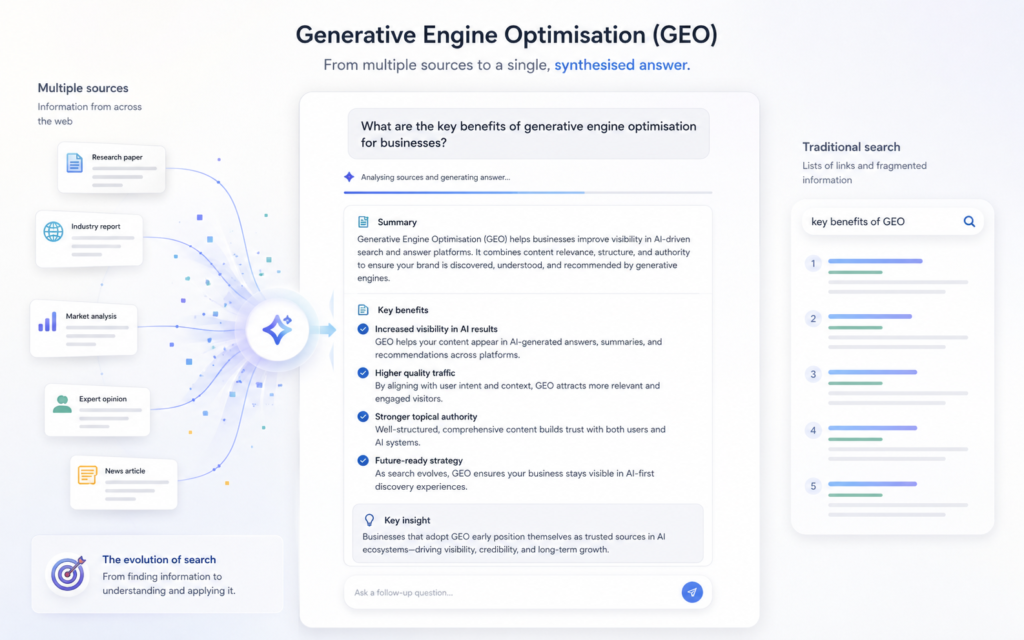
Google isn’t the only search engine that matters anymore. AI-powered search tools like ChatGPT, Google AI Overviews, Perplexity, and Claude are changing how people discover businesses. Instead of scrolling through ten blue links, your customers are getting a single, synthesized answer — and that answer names specific businesses by name.
This is where Generative Engine Optimization comes in. GEO is the next evolution of small business digital marketing, and it’s reshaping what it means to “be found online.” If SEO was the oxygen of online visibility, GEO is the catalyst that makes it work in the AI era.
What Is Generative Engine Optimization (GEO)?
Generative Engine Optimization (GEO) is the practice of structuring your website content so that AI-powered search tools cite, reference, and recommend your business when answering user questions.
When someone types “What’s the best way to get more restaurant bookings?” into ChatGPT, or asks Perplexity “How do I automate my invoicing?” — those tools don’t return a list of links. They read thousands of web pages in seconds, synthesize the information, and write a conversational answer — naming specific businesses and resources along the way. GEO is how you become one of those named sources.
The term was introduced in a 2023 research paper by Princeton University and Georgia Tech. You might also hear it called Answer Engine Optimization (AEO) or LLM Optimization (LLMO), but GEO has become the most widely adopted term.
What makes Generative Engine Optimization different from simply “writing good content” is that it’s designed for how AI reads and selects sources. AI looks for direct answers, structured information, and signals of authority and freshness — and it decides in milliseconds whether your content is worth citing.
Think of GEO as teaching AI who you are, what you do, and why you’re the best answer to your customer’s question.
Why Does Generative Engine Optimization Matter for Small Businesses in 2026?
The numbers are hard to ignore. Gartner projects traditional search volume will drop 25% by 2026, with AI absorbing that share. Over 58% of Google searches already end without a click. ChatGPT processes 2.5 billion prompts per day. AI-referred web sessions jumped 527% year-over-year in early 2025.
Every era of business has its turning point. Electricity. The internet. Mobile. Now it’s AI.
Here’s what should encourage you: small businesses are better positioned for GEO than most people realize. The Princeton research found that GEO tactics produced up to 115% visibility improvement for lower-ranked websites, while dominant sites actually saw decreases. Unlike traditional SEO where backlink profiles and domain authority favor incumbents, AI search engines prioritize direct answers, structured data, and freshness — things any small business can deliver.
GEO isn’t here to replace your SEO work. It’s the building block that makes everything you’ve already built work harder across every AI search engine, not just Google.
How Do AI Search Engines Decide What to Cite?
Each AI platform selects sources differently, but they share common patterns. ChatGPT searches Bing’s index and weights review platforms and curated lists. Google AI Overviews favors content that answers queries directly within the first 200 words. Perplexity emphasizes recency and specific data points. Claude draws from authoritative databases and documented expertise.
The common thread: your website content, Google Business Profile, reviews, and structured data all directly influence whether AI recommends you. These are the same foundations of good digital marketing you should already be building — GEO just gives you a framework for making them work across every AI platform.
GEO vs. Traditional SEO — What’s the Difference?
SEO gets you clicked. Generative Engine Optimization gets you quoted.
Traditional search engine optimization services focus on ranking in a list of links. GEO focuses on getting your business cited inside the AI-generated answer itself — often before the user sees any links.
The key differences: SEO measures click-through rate and ranking position, while GEO measures brand citations and AI mentions. SEO rewards keyword-optimized long-form content, while GEO rewards direct-answer formatting and structured data. SEO leans on backlinks and domain authority, while GEO prioritizes schema markup, freshness, and entity consistency.
Generative Engine Optimization doesn’t replace SEO — it layers on top. If you’ve invested in solid content marketing and SEO, GEO is how you make that investment pay off across ChatGPT, Perplexity, and every other AI search engine.
Worth noting: AI search traffic converts at significantly higher rates than traditional search — some studies suggest up to five times higher. When AI names your business as a recommendation, it carries an implicit endorsement a blue link never does.
5 Ways to Optimize Your Small Business for Generative Engine Optimization
Most GEO tactics are things any small business can start today. Here are the five that matter most.
1. Answer Questions Directly in Your Content
AI extracts the first 100 to 200 words of a page when deciding whether to cite it. Every service page and blog post should lead with a clear answer — not build up to it. If your page is about AI chatbots for websites, the first sentence should define what an AI chatbot does. If it covers AI scheduling tools, open with a direct explanation. Give AI the extractable answer first, then add context.
2. Add Schema Markup to Your Website
Schema is structured data that tells AI exactly what it’s looking at — your business name, services, hours, reviews. The types that matter most for GEO are LocalBusiness, FAQ, Service, and Article schema. Free tools like Google’s Structured Data Markup Helper make this accessible without a developer. Without schema, you’re making AI work harder to understand your content — and AI will always choose the source that makes its job easiest.
3. Keep Your Google Business Profile Complete and Current
AI tools — especially Google AI Overviews and Perplexity — pull heavily from Google Business Profile data. Your GBP is often the first thing AI checks before looking at your website. Fill every field with detailed information: service descriptions, categories, hours, photos, and recent reviews. Investing in local business SEO starts with getting this right.
4. Publish Fresh, Authoritative Content Regularly
AI engines weight recency. A 2024 guide loses ground to a 2026 article on the same topic. The more regularly you publish, the more AI treats your site as a credible authority. This is where AI content creation tools become practical — using AI to produce blog and email drafts and social media marketing posts keeps you publishing consistently without a full content team. Include specific statistics and original data wherever possible — they’re citation magnets for AI.
5. Build Consistent Citations and Reviews Across the Web
AI cross-references multiple sources to validate your business. Reviews on Google, Yelp, and industry directories all feed into AI’s confidence. Consistent NAP (Name, Address, Phone) data across every listing matters — if your information doesn’t match across platforms, AI has less confidence recommending you. For both Generative Engine Optimization and traditional local SEO services, this is foundational.
What Happens If You Ignore GEO?
You won’t lose your Google rankings. But you’ll become invisible in an increasingly important channel. Citation authority in AI search compounds over time — the businesses building it now will be harder to displace later. Most small businesses haven’t heard of Generative Engine Optimization yet. That’s your window, but it’s temporary.
The businesses that AI cites today are the ones it will keep citing tomorrow.
How Salient AI Helps Your Business Get Found by AI
This is exactly what we do at Salient AI. Our digital marketing agency services create the structured, citable content AI engines need to recommend you. Our AI lead generation services capture the leads GEO generates — with AI chatbots for websites, AI receptionist services, and AI follow-ups working around the clock. And our AI workflow automation handles scheduling, AI invoicing and reporting, and AI customer support — so you can focus on growth.
Generative Engine Optimization is the newest element in the periodic table of business growth. It doesn’t replace what you’ve built. It extends your capability into the places where your customers are increasingly looking.
Book your free consultation today and find out how AI search is already talking about businesses like yours — and how to make sure it’s saying the right things.